

Are Foam Water Blasters Safe for Toddlers? A Parent's Guide
Editorial TeamTable of Contents
- Are Foam Water Blasters Safe for Toddlers? The Short Answer
- Water Blaster Age Recommendation: When Is a Toddler Ready?
- Water Toy Eye Safety: Protecting Faces and Eyes During Play
- Water Toy Choking Hazards and Water Ingestion Risks
- Supervised Water Play for Toddlers: Rules That Actually Work
- How to Choose and Inspect a Toddler-Appropriate Foam Water Blaster
- Safe Water Play Around Pools, Baths, and Splash Pads
- Frequently Asked Questions
Last Updated: October 17, 2026
Are Foam Water Blasters Safe for Toddlers? The Short Answer
Yes, with the right supervision and the right toy. Foam water blasters are among the gentler water toys you can hand a small child, because the body is soft foam rather than hard plastic.
A foam water blaster is a soft-bodied water toy that soaks up water, then sprays it through a pump trigger when a child pushes it. The foam shell means a dropped or swung blaster won't crack against a sibling's head the way a rigid plastic water gun can.

That's the good news. The catch is that toddlers are unpredictable, and no toy is self-supervising.
Below, we'll show you exactly how to judge readiness, what to check before every use, and which play rules actually hold up with a two- or three-year-old.
Water Blaster Age Recommendation: When Is a Toddler Ready?
Most foam water blasters carry a label suggesting age three and up, and that's a reasonable starting point rather than a verdict.
The reason age labels cluster around three is developmental, not arbitrary. Around that age, most children can follow a two-step instruction, tolerate a little frustration when a pump trigger resists, and understand that a spray has a direction.
What readiness actually looks like, age by age
Under two. A pump-trigger blaster is usually a poor match. Toddlers this age explore with their mouths, have limited hand strength, and can't yet connect pumping with spraying.
Two to three. This is the transitional window. Children start to grasp cause and effect, pump, water comes out, and they enjoy the repetition. Aim is unreliable, and a face shot is likely if another child is in range.
Signs your toddler is ready for a foam water blaster
Watch for these green lights before you hand one over:
- Can follow a simple "stop" instruction and actually pause
- Has the hand strength to work a pump trigger without frustration
- Understands "aim at the ground" or "aim at the fence"
If your child hits most of these, they're likely ready for supervised play. If not, wait. There is no prize for starting early, and a frustrating first experience can make a child wary of water play for a while.
Why the label is not the whole answer
A toy can be labeled for ages three and up and still be a poor fit for a specific three-year-old who mouths everything or can't yet follow a stop cue. The label is a floor, not a ceiling. The better question is not "is my child old enough for this toy?" but "can my child use this toy the way it's meant to be used, with me right there?" If the answer is no, the toy waits.
Water Toy Eye Safety: Protecting Faces and Eyes During Play
Eyes are the number one concern with any water toy, and for good reason.
Set a firm rule before the first squirt: aim below the shoulders. Say it, model it, repeat it. Toddlers learn rules through repetition, not one-time lectures.
A few habits that make a real difference:
- Start with low water pressure. Fill the blaster partway and let your child practice on a fence or driveway first.
- Keep a towel handy for quick face wipes.
- Teach the "aim down" habit every single time, not just once.
- Play one-on-one at first so you can stay within arm's reach.
The American Academy of Pediatrics guidance on water safety stresses constant adult supervision around any water activity, and toy water play is no exception.
Water Toy Choking Hazards and Water Ingestion Risks
Choking and swallowing are the quieter risks with any water toy, and they get far less attention than eye shots. For toddlers, they deserve a close look, because the hazards are not always obvious from the outside of the toy.
Where the choking risk actually comes from
A well-made foam water blaster is usually one molded piece, which removes most of the risk. The trouble comes from three places:

- Detachable parts. Nozzles, caps, and end plugs are the usual culprits. If a piece can be pulled off by a determined toddler, treat it as a choking hazard and retire the toy.
- Foam breakdown. Foam that has dried out, been left in sun, or been chewed can flake or crumble. Small foam bits are exactly the size a toddler puts in their mouth.
- Chewing and mouthing. Toddlers explore with their mouths, and a soft foam body invites biting in a way a hard plastic gun does not. A chewed blaster is a damaged blaster.
Run a quick inspection each time the blaster comes out:
- Squeeze the foam body for cracks or tears
- Pull gently on the trigger to confirm it's secure
- Check the nozzle for loose pieces
- Look for any foam bits flaking off
If anything feels loose or torn, retire the blaster. A replacement is cheap; a choking scare is not.
Water ingestion: the risk beyond being sprayed
Toddlers swallow water when they laugh mid-spray, when they spray toward their own mouths, and when they drink from the blaster like a bottle. In a backyard with a hose, most of this is harmless. The picture changes around pools, splash pads, and standing water, where swallowed water can carry germs.
Keep these points in mind:
- Don't let your child drink from the blaster. Say it once before play and again if you see it.
- Watch for mouthing, especially with kids under two.
- Rinse the toy after pool or splash pad use so it doesn't hold chlorinated or standing water.
- Skip standing water sources like buckets or kiddie pools that have sat out for days.
Cleaning and storage that reduce the risk
A blaster that stays wet and warm between uses is a good place for mold and bacteria to grow, and a toddler will put that toy near their mouth. After each session, empty the blaster, rinse it with clean water, and let it air-dry fully before storing. Skip the sealed bin while it's still damp. A quick visual check for dark spots or a musty smell before the next use tells you whether it needs a deeper clean or replacement.
Supervised Water Play for Toddlers: Rules That Actually Work
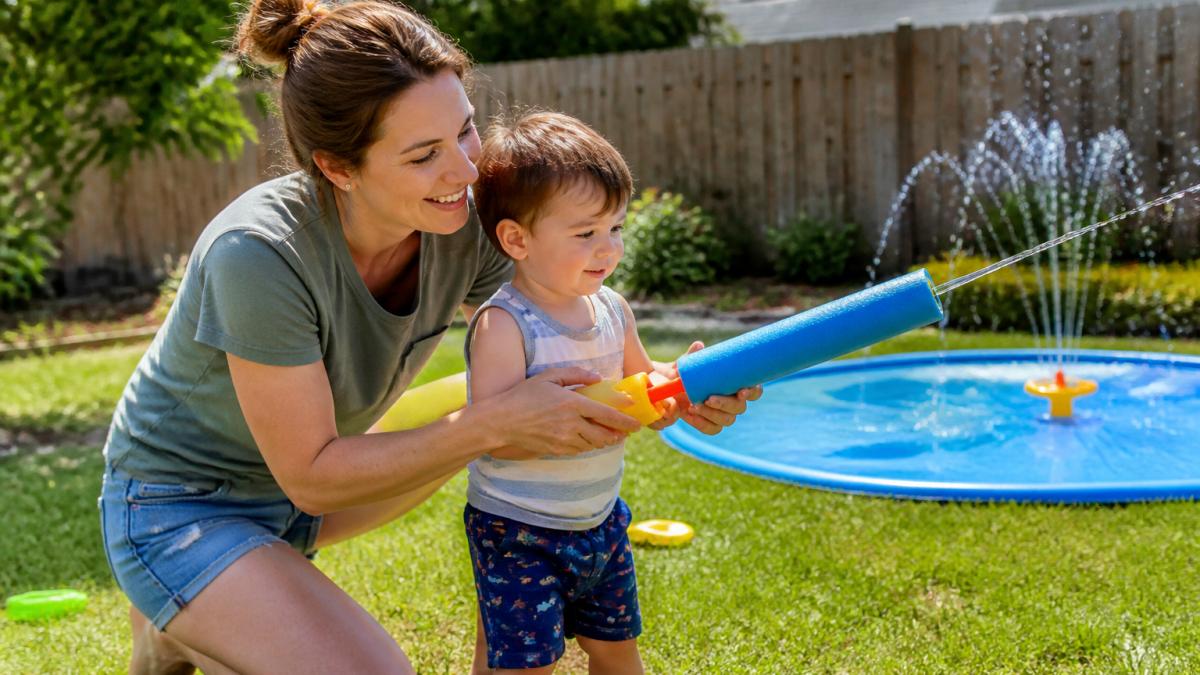
Rules only work if a toddler can remember them. Keep the list short and say it the same way every time.
Here's what we've found holds up best:
- "Aim down." Water goes at the ground, the fence, or the grass.
- "No faces." Say it before play starts, not after a squirt lands.
- "One at a time." Toddlers get overwhelmed in group water fights.
- "Stay where I can see you." Set a clear boundary, like the edge of the patio.
- "Stop means stop." Practice it during play so it's a game, not a punishment.
Stay within arm's reach the whole time. That's the rule that makes all the others work.
How to Choose and Inspect a Toddler-Appropriate Foam Water Blaster
Look for a blaster that's small enough for small hands, light enough to carry, and built as one solid piece.
Our consumer toy safety guidance from the Consumer Product Safety Commission recommends checking age labeling and inspecting toys for loose parts, and that applies directly here.
A toddler-friendly blaster should have:
- A compact body your child can grip with two hands
- A light weight so it doesn't drag or get dropped
- A soft foam shell with no hard edges
- A simple pump trigger that isn't stiff
Our Oodles of Noodles Foam Water Blaster 4-pack is built for exactly this: soft foam bodies, a compact size, and a pump trigger kids can manage.
For bigger gatherings, the 24-pack makes sense. For a single family, the 4-pack covers siblings and a friend without overbuying.

Safe Water Play Around Pools, Baths, and Splash Pads
Water play near a pool raises the stakes, because the toy is no longer the main risk. Drowning prevention comes first, always.
The CDC's drowning prevention resources are blunt about this: young children should have an adult within arm's reach whenever they're near water.
Around pools and splash pads:
- Keep the blaster out of the pool itself so kids aren't leaning in to refill it
- Designate a fill station away from the water's edge
- Stay within arm's reach the entire time
- Empty and rinse the blaster after splash pad use
The key difference between a backyard and a pool is simple: in the yard, you're managing a toy.
Frequently Asked Questions
Are foam water blasters safe for toddlers?
Foam water blasters are generally a safer choice than hard plastic water guns because the foam body is soft and won't sink, which lowers the risk of impact injuries during play. That said, safety still depends on age, supervision, and how the toy is used. Toddlers should always be watched by an adult, told not to aim at faces or eyes, and checked for loose parts before each session. Choose a compact size that fits small hands and inspect the foam for tears after every use.
What age is appropriate for a water blaster?
Most toddlers can start handling a small foam water blaster around age two to three with close adult supervision, once they can follow simple directions like 'aim at the ground' or 'don't spray faces.' Younger toddlers may do better watching or splashing with hands first. The water blaster age recommendation depends less on the number and more on whether your child can grip the toy, pump the trigger, and understand basic play rules. Start with short sessions and a compact model.
Can a water blaster hurt a toddler's eyes?
A direct spray to the eye from any water toy can sting, and repeated hits may cause irritation, so water toy eye safety matters. Foam blasters reduce the risk of blunt impact from a hard barrel, but the stream itself can still bother eyes. Teach toddlers to aim at the body and legs, keep a safe distance, and never shoot toward faces. If water gets in an eye, rinse gently with clean water and watch for redness or discomfort.
Are foam water blasters choking hazards?
Foam water blasters are not typically small enough to be swallowed whole, but water toy choking hazards can come from torn foam pieces, loose caps, or small parts that break off over time. Inspect the blaster before every use, tug on the trigger and any attached pieces, and discard the toy if the foam is ripped or crumbling. Keep an eye on toddlers during play so they don't put foam bits in their mouths, and store blasters out of reach between sessions.
Toddler water play works best when the toy is soft, the rules are simple, and you're close enough to redirect a stray spray. Foam water blasters fit that bill well, as long as you pick the right size, check them before each use, and stay within arm's reach. FoamNoodles carries soft foam water blasters in 4-packs and 24-packs, plus fast, free shipping and bulk pricing for camps and parties. Get started with FoamNoodles and give your toddler a water toy that's built for small hands and safe play.