

Table of Contents
- Quick Comparison: Bulk Foam Pipe Insulation Options
- What Makes Pipe Insulation Commercial Grade
- ASTM C547 Pipe Insulation Standards and Fire Ratings
- Tools for Professional Pipe Insulation Installation
- Pipe Insulation Thickness Calculation for Contractors
- Preventing Condensation and Heat Loss in Piping Systems
- Buying in Bulk: Procurement and Lifecycle Costs
- Frequently Asked Questions
Last Updated: September 17, 2026
Quick Comparison: Bulk Foam Pipe Insulation Options
Commercial grade pipe insulation comes down to three things: wall thickness that matches the pipe diameter, a fire rating you can show an inspector, and a bulk price that keeps material cost per linear foot predictable. FoamNoodles stocks pre-slit closed-cell foam in three bulk box sizes.
Here is how the bulk options compare:
| Product | Fits Pipe Size | Count per Box | R-Value | Price |
|---|---|---|---|---|
| Foam King Bulk Pipe Insulation 1/2 in. x 3 ft. | 1/2 in. copper, 3/8 in. iron | 180 | 2.2 | $209.99 |
| Foam King Bulk Pipe Insulation 3/4 in. x 3 ft. | 3/4 in. copper | 145 | 2.2 | $199.99 |
| Foam King Bulk Pipe Insulation 1 in. x 3 ft. | 1 in. copper | 100 | 2.2 | $209.99 |
What Makes Pipe Insulation Commercial Grade
Commercial grade means published fire performance data and a temperature rating you can hand to a specifier. Residential foam often ships with neither.

Residential vs. Commercial Pipe Insulation
Residential foam covers a water heater line in a basement. Commercial foam has to satisfy a mechanical inspector, a general contractor, and sometimes a fire marshal on the same project.
The practical differences come down to documentation and durability:
- Fire ratings: Commercial products publish ASTM E84 flame spread and smoke results. Residential products may not test at all.
- Temperature range: A stated range like -90°F to 180°F tells you the material survives both a cold snap and a hot water line.
- Wall thickness: Commercial work specifies thickness by pipe diameter and service temperature, not by whatever fits.
- Vapor barrier: Chilled and cold lines need a closed-cell structure that resists moisture migration.
ASTM C547 Pipe Insulation Standards and Fire Ratings
Specifiers who want the full testing framework can review the ASTM C547 standard scope alongside the E84 results on the product data sheet.
Tools for Professional Pipe Insulation Installation
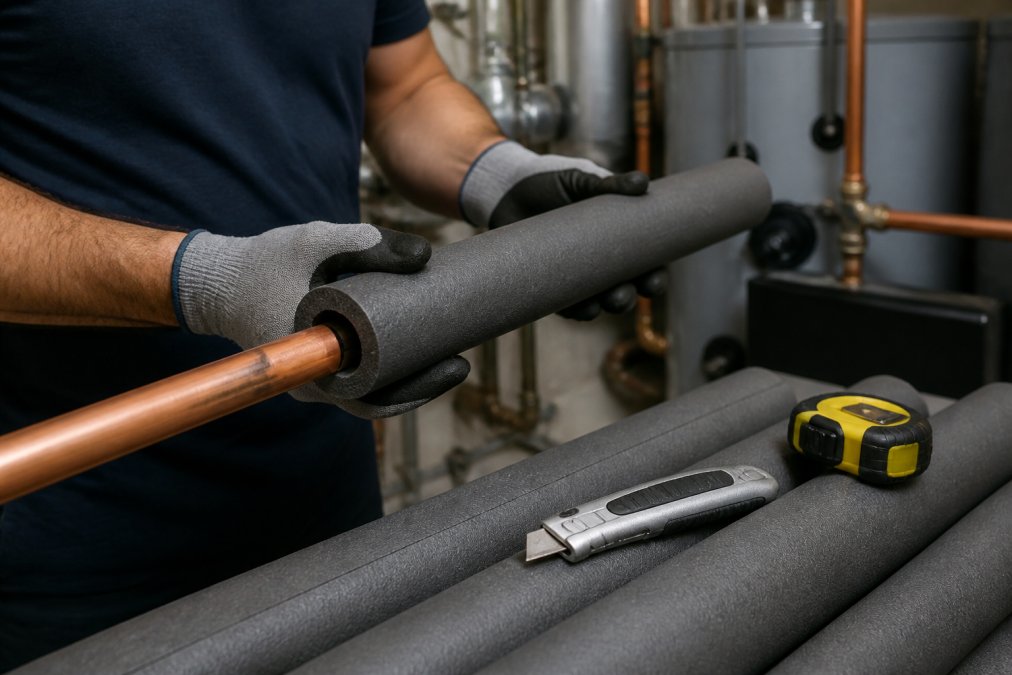
Professional installation needs four inexpensive tools: a sharp utility knife, a tape measure, a straightedge, and clean work gloves.
Pipe Insulation Thickness Calculation for Contractors
Pipe insulation thickness calculation for contractors starts with three inputs: pipe outside diameter, the temperature difference between the line and the surrounding air, and whether the goal is condensation control or energy efficiency. Get those three right and the rest is table lookup, not math. For condensation control, the wall thickness must keep the outer surface above the dew point of the surrounding air.
The Two Design Conditions
Condensation control (cold lines). The controlling number is the dew point, not the air temperature. A 45°F chilled water line in a 75°F mechanical room at 55% relative humidity has a dew point near 58°F, and the insulation surface has to stay above that. Thicker wall means more margin, which is why sub-ambient work is sized by humidity, not pipe size.
A Field Method That Actually Works
- Measure the pipe outside diameter with a caliper or wrap a tape and divide by pi. Note the nominal size separately, a 3/4-inch copper tube measures about 7/8 inch outside.
- Record the line temperature, surrounding air temperature, and relative humidity. On cold lines, humidity decides the wall.
- Look up the dew point for that air temperature and humidity pairing. Most mechanical code references and ASHRAE tables publish this directly.
- Pick the wall thickness whose published surface temperature stays above that dew point with margin. Use the manufacturer's surface temperature tables instead of guessing.
- Confirm the sleeve's stated pipe size matches your measured outside diameter, not the nominal size on the drawing.
Why the Wall Thickness Table Beats the Formula
The underlying calculation is a heat transfer equation accounting for conduction through the insulation wall, surface film resistance, and the temperature difference driving the flow. Published thickness tables compress that work into a lookup keyed on pipe size, line temperature, and ambient conditions. A common pattern on commercial domestic water: 1/2-inch wall on lines up to 2 inches, stepping to 1-inch wall on larger mains and on any line where the spec calls out a specific surface temperature.
When the Calculation Points Away From Foam
If the required thickness exceeds what a closed-cell sleeve can deliver, or the line temperature sits above the material's rated ceiling, the calculation is telling you to change material family, not to stack sleeves. Recognizing that crossover point early saves a submittal rejection later.
Preventing Condensation and Heat Loss in Piping Systems
Condensation control and heat loss prevention are two separate problems that share one solution: a continuous, sealed vapor barrier over closed-cell foam. Sweating happens when humid air meets a cold pipe surface, the water condenses out of the air, not through the pipe. Insulation keeps the outer surface warm enough that the moisture stays in vapor form. On a hot water line, the foam slows thermal conductivity so the water arrives hot and the heater works less. Foam King sleeves reduce heat loss, lowering the water heater's workload and delivering faster hot water at the tap.
Foam King Bulk Pipe Insulation - 1/2 →

Chilled Water Systems and Vapor Barriers
Chilled water systems and sub-ambient insulation demand the strictest vapor barrier discipline of any piping application. A single unsealed butt joint on a 45°F chilled water line will sweat through and drip within a season.
Three rules govern chilled water work:
- Seal every joint. Butt ends tight, then tape or seal per spec.
- Never compress the foam. Compression thins the wall and drops the R-value at exactly the point where condensation starts.
- Protect the surface. Insulation jacketing and protective cladding keep UV, abrasion, and jobsite traffic from opening the barrier.
Buying in Bulk: Procurement and Lifecycle Costs
Bulk purchasing changes the math on a commercial job more than any single product choice. Material cost per linear foot falls when you buy by the box, and labor savings compound because your crew is not stopping to reorder mid-project. The real advantage is a procurement workflow that matches the takeoff.
Building the Takeoff Before You Order
Contractor-specific procurement starts with a count, not a catalog. Pull the pipe schedule from the drawings, sort by nominal diameter, and total the linear feet per size. Add a waste factor, most mechanical contractors use 5% to 10% on straight runs and more where fittings cluster. Then convert linear feet to boxes. A 1,200-linear-foot run of 1/2-inch copper needs 400 sleeves before waste; at 180 sleeves per box, that is three boxes with margin.
Matching the Diameter Mix to the Drawings
| Job Type | Recommended Box | Why |
|---|---|---|
| Multi-family rough-in, mixed small lines | 1/2 in. x 3 ft., 180 count | Highest piece count per box, covers the most common line size |
| Standard commercial domestic water | 3/4 in. x 3 ft., 145 count | Matches the most common copper diameter on commercial drawings |
| Larger distribution mains | 1 in. x 3 ft., 100 count | Fewer pieces, larger diameter, less waste on long straight runs |
| Small repair and service calls | 4 Pack Foam King Pipe Covers | Right quantity for a service truck without carrying a full box |
The Procurement Workflow That Keeps Crews Working
- Takeoff by diameter. Sort the pipe schedule into size buckets before you touch a supplier page.
- Apply waste. 5% to 10% on straight runs, more where fittings cluster.
- Convert to boxes. Round up per diameter, not on the total.
- Stage by floor or zone. Label boxes by diameter before they hit the site so the right sleeve goes to the right riser.
- Hold one spare box per diameter. On any job over 100 linear feet, running short mid-rough-in costs more in crew downtime than the box costs outright.
Lifecycle Cost: The Framework Clients Ask For
Lifecycle cost is where the bulk decision pays off twice, and it is the number a general contractor or building owner will ask you to justify. The framework is straightforward even without a spreadsheet:
- Upfront material cost, box price divided by linear feet covered, per diameter.
- Labor cost, installation time per linear foot, which drops when the crew is not cutting around mismatched sizes.
- Energy cost over the system life, the heat loss the insulation prevents, valued at the local utility rate over the expected service life.
- Failure cost avoided, a properly sealed closed-cell sleeve that keeps its vapor barrier for the life of the system avoids the two most expensive outcomes in piping: a burst pipe in winter and a dripping chilled water line above a finished ceiling.
Sustainability and Documentation
Reducing heat loss lowers the building's energy load, and documented fire performance supports the submittal package a green-building project requires. Contractors who track material by box also generate cleaner waste numbers for projects with construction waste diversion targets. Keep the box count and linear-foot coverage on the same sheet as your takeoff, that record is what a project team needs at closeout.
Frequently Asked Questions
What is the difference between commercial and residential pipe insulation?
Residential pipe insulation usually covers a handful of water lines with thin foam sleeves. Commercial grade pipe insulation for contractors is specified for larger pipe diameters, longer runs, and harsher conditions, including chilled water systems, steam piping, and rooftop HVAC lines. It is also held to published fire and smoke ratings such as ASTM E84 and carries documentation for inspections. Foam King bulk insulation, for example, is rated Class A on both flame spread and smoke, with an R-value of 2.2 and a -90F to 180F temperature range.
How do contractors determine the required thickness for pipe insulation?
Pipe insulation thickness calculation for contractors starts with three inputs: pipe diameter, the temperature difference between the pipe and the surrounding air, and the R-value needed to stop condensation or limit heat loss. Manufacturers publish thickness tables keyed to those inputs. On cold lines, the deciding factor is usually keeping the surface temperature above the dew point; on hot lines, it is meeting an energy target. When in doubt, size up one thickness rather than down.
What are the ASTM standards for commercial pipe insulation?
ASTM E84 measures surface burning characteristics and is the rating most inspectors ask to see. Foam products often also carry CAN/ULC-S102.2-M88. Check the label for flame spread and smoke classification before you install anything in an occupied building. Foam King pipe insulation carries Class A ratings under both ASTM E84 and CAN/ULC-S102.2-M88, so the paperwork is on the product.
How does pipe insulation prevent condensation in commercial HVAC systems?
Condensation forms when humid air meets a cold pipe surface. Insulation with a closed-cell structure and a vapor barrier keeps that surface above the dew point and blocks moisture from reaching the pipe. Pre-slit foam sleeves such as Foam King are designed for this, and the R-value of 2.2 combined with the -90F to 180F range handles both chilled water systems and hot lines. Seal every joint tightly, because gaps let humid air straight through.
Can I use the same pipe insulation on hot and cold lines?
Foam King pipe insulation is rated for both, with a working range of -90F to 180F, which covers domestic hot water, chilled water, and most HVAC piping. Steam lines run hotter than that, so they need a different material. If you are insulating a mixed mechanical room, keep the foam for the water and HVAC runs and spec a high-temperature product for steam. That split keeps you inside the published limits.