

Table of Contents
- Why Couch Cushions Lose Shape
- How to Restuff Couch Cushions Step by Step
- Choosing Couch Cushion Replacement Foam
- How to Make Couch Cushions Firmer
- Flipping, Rotating, and Daily Habits That Prevent Sagging Couch Cushions
- Cost and Effort: Repair vs. Replace Sagging Couch Cushions
- Frequently Asked Questions
Last Updated: October 21, 2026
Why Couch Cushions Lose Shape
Sagging couch cushions have one of two causes: the foam inside has broken down, or the frame underneath has failed. Most guides treat these as the same issue.
Cushion wear is the slow collapse of the foam core.
Frame and support failure looks identical from above. Weak springs, a cracked deck, or a stretched webbing strap let the whole seat sink. The cushion is fine.
This guide from FoamNoodles walks you through both.
Worn Cushions vs. a Sagging Frame
Run this test before you buy anything:
- Pull the cushion off and press the deck or springs with your palm. Spongy give is normal. A hard bottom-out or a rattle means the support has failed.
- Lay the cushion on a flat floor. If it rocks or sits lower in the middle, the foam is compressed.
- Squeeze a corner between thumb and fingers. Foam that crumbles or stays pinched has lost its structure.
- Check the seams and zipper. A split seam is a sewing job, not a foam job.
If the deck presses firm and the cushion still looks flat, you have a cushion problem. Keep reading.
How to Restuff Couch Cushions Step by Step
Restuffing means opening the cover, replacing or adding filling, and closing it back up. Budget about an hour per cushion the first time, less after that.
Here is the sequence we recommend:
- Unzip the cover and work the insert out. Go slow at the corners where the fabric grips.
- Measure the insert at its widest points: length, width, and thickness.
- Assess the foam core. If it holds its shape and only feels soft, you can add filling. If it crumbles or has gone thin, replace it.
- Add or replace the fill, working from the center outward so the cushion fills evenly.
- Test the fit by pressing the insert back into the cover before you zip. Adjust now, not later.
- Zip, smooth, and place. Give it a day to settle before judging the result.
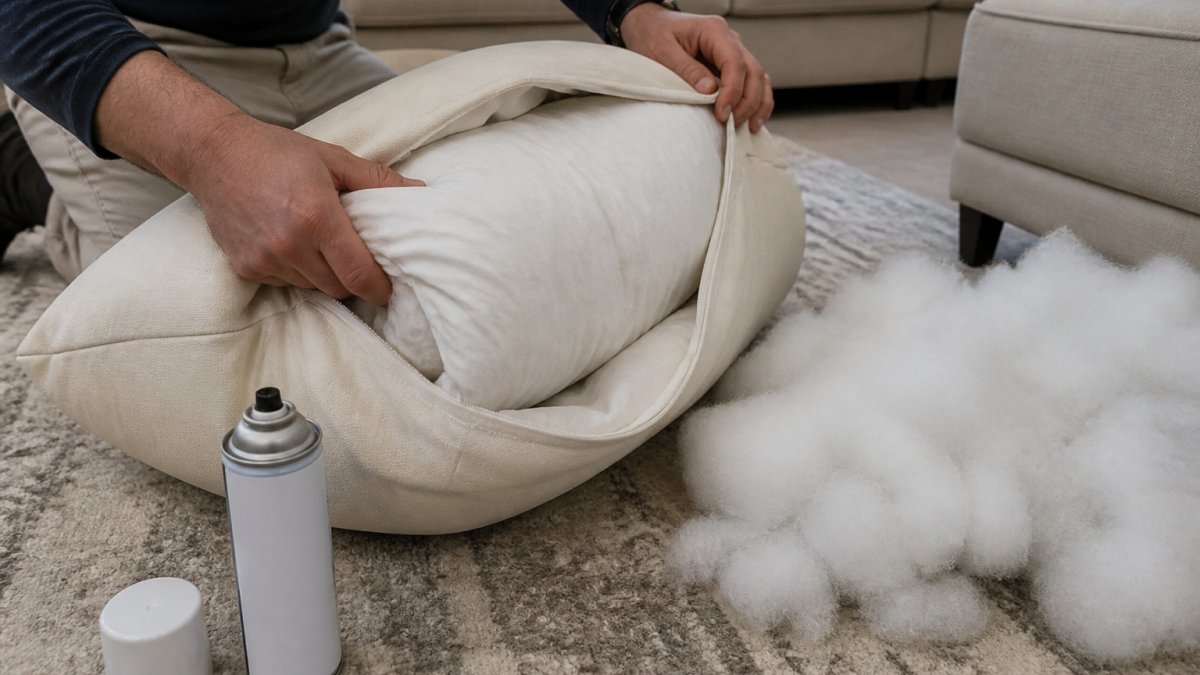
Opening the Cover and Accessing the Insert
Construction decides how much you can do.
Zippered covers are the easy case. Open the zipper fully, then push the insert toward the opening from the far end rather than pulling it. Pulling stretches the seams.
Sewn-shut covers need a seam opened along one edge with a seam ripper, then hand- or machine-stitched closed. Pick a seam on the back or bottom edge so the repair hides.
Cushions with an attached deck (the fabric panel sewn to the frame) cannot be fully removed. You can still add filling through an opened seam, but expect a tighter working space.
Choosing Couch Cushion Replacement Foam
Couch cushion replacement foam is judged on three things: firmness and thickness. Get them right and the cushion lasts; get them wrong and you will be back here in six months.
Firmness is personal but also structural. A soft cushion bottoms out fast under a heavier sitter; a firmer one holds its shape longer.
Thickness must match the cover. Too thin leaves the cover baggy and creases the seams; too thick strains the zipper and the cover never sits flat.
Matching Foam to Cushion Construction
The right foam depends on how the cushion is built, not just its dimensions.
- Foam-core cushions with a zippered cover are the simplest case. Replace the core or add a layer, and test the fit before zipping.
- Foam-core cushions with a sewn-shut cover need a seam opened along the back or bottom edge. Plan the closure before you cut foam, since the opening is smaller than a zipper.
- Loose-fill cushions (no foam core, just fiber or shredded foam) are topped up rather than replaced. Adding a foam slab changes how they sit and is usually the wrong move.
- Attached-deck cushions cannot be fully removed, so you add filling through an opened seam rather than rebuilding the core. Keep the added layer thin so the cushion still seats in its well.
A Practical Selection Sequence
- Measure the old insert at length, width, and thickness. If the old insert has collapsed, add back the thickness it has lost, a cushion that started at 6 inches and now measures 4 needs a 6-inch replacement, not a 4-inch one.
- Match the original thickness first. Thickness is the dimension the cover cannot forgive.
- Choose firmness for the seat, not the showroom. A seat used daily wants slightly firmer foam than a decorative cushion. Slightly firm foam settles into comfortable; soft foam only gets softer.
- Let a week of sitting do the final fitting. New foam feels firmer than broken-in foam and softens with use. Judge it after a week, not an hour.
Durability and What to Expect
No foam lasts forever, and a repaired cushion is a repair, not a new couch. A well-matched replacement core restores comfortable seating for several years of normal household use, while a thin added layer buys time rather than solving the problem. Foam too soft for the sitter's weight and too thin for the cover both shorten that life by concentrating load in the spots that failed first.
12ft Sofa Slipcover Tuck Grip Rope Non Slip Foam Couch Cushion Cover Grip →
How to Make Couch Cushions Firmer
You can make couch cushions firmer without replacing the foam, as long as the core is still sound.
Add a firm layer. Cut a sheet of EPE foam to the cushion's footprint and slide it under or over the existing core.

Wrap the core in batting. A layer of batting or Dacron around the foam adds loft and smooths the corners; spray adhesive holds the wrap while you slide it into the cover.
Top up with loose fill. Polyester fiber fill, often sold as Poly-fil, packs into corners and edges where foam has gone thin.
Which Fix Fits Which Cushion
| Symptom | Best first fix | Why |
|---|---|---|
| Cushion bottoms out, core still sound | EPE foam layer under the core | Adds support without changing the top feel |
| Edges thin, center still firm | Batting wrap | Restores loft and silhouette |
| Corners soft, overall shape okay | Loose fill in small amounts | Cheapest fix for localized collapse |
| Core crumbles or has gone thin overall | Replace the core | No added layer fixes broken-down foam |
| Cushion sags but deck feels soft | Check the frame first | Filling will not fix a support failure |
Adhesive and Material Compatibility
Spray adhesive is the usual way to hold batting to foam, and compatibility matters. Use an adhesive labeled for foam and fabric, apply a light, even coat, and let it tack before pressing the batting down.
Ventilate while the adhesive cures. Most spray adhesives off-gas for several hours, and a cushion assembled in a closed room will smell for days.
EPE foam is compatible with common spray adhesives and batting wraps, which makes it easier to work with on a repair.
How Long Each Fix Lasts
Set expectations before you start. A foam layer plus a batting wrap is the best balance of cost and result for most couches and typically holds a year or more. Loose fill alone is the shortest-lived fix because it settles. Replacing the core lasts longest of the DIY options. None of these fixes outlast the frame underneath them, a cushion that sags because a spring has popped will sag again no matter what you put inside it.
Flipping, Rotating, and Daily Habits That Prevent Sagging Couch Cushions
Most sagging couch cushions can be delayed with a two-minute habit: rotate and flip every cushion once a month so wear spreads evenly instead of concentrating in one spot.
Build these into your routine:
- Flip and rotate monthly. Swap left for right, and turn each cushion over. Mark the underside with a small tag if you lose track.
- Beat the cushions weekly. Take them outside and pat them firmly to loosen compressed fill and dust.
- Keep seats off the sun. Direct sun breaks down foam over time, so rotate the couch or use a throw.
- Discourage the same seat. Everyone has a favorite spot. Rotating cushions spreads the load.
- Vacuum the seams. Dust and crumbs work into the seams and abrade the fabric.
If your slipcover shifts every time someone sits down, a grip helps. Our 12ft Sofa Slipcover Tuck Grip Rope tucks into the crevices to hold the cover in place, which keeps the cushion underneath from bunching.

Cost and Effort: Repair vs. Replace Sagging Couch Cushions
Repairing is almost always cheaper than replacing and usually faster than waiting on a delivery. The trade-off is your time.
| Option | Effort | What It Fixes | Best For |
|---|---|---|---|
| Flip and rotate | Minutes a month | Even wear | Cushions still firm |
| Add loose fill | 30 minutes | Soft corners, thin spots | Minor sagging |
| Foam layer plus batting | 1 hour per cushion | Lost support and loft | Moderate sagging |
| Replace the foam core | 1-2 hours per cushion | Crumbling or thin foam | Heavy wear |
| Replace the cushions | Shopping and delivery time | Everything | Covers and foam both worn out |
Flipping and rotating costs nothing and should be your first move. Adding loose fill is the cheapest real repair, but it settles and needs topping up. A foam layer plus batting is the best balance of cost and result for most couches. Replacing the core is the closest thing to new cushions without buying new ones. Full replacement makes sense when the covers are torn as well as the foam.
Frequently Asked Questions
Why do sofa cushions sag?
Sofa cushions sag for three main reasons: the foam core compresses and loses loft over time, the polyester fiber fill inside the insert bunches toward the back, or the frame and springs underneath have weakened. Before you buy anything, press on the deck of the sofa with the cushions removed. If the deck feels solid, the problem is in the cushions and a restuff or foam replacement will fix it. If the deck dips, the frame or springs need attention first.
Is it worth restuffing sofa cushions?
Restuffing is usually worth it when the cover fabric is still in good condition and the foam core has not crumbled. A bag of polyester fiber fill costs a fraction of a new cushion set, and you can finish the job in an afternoon. Skip the repair if the fabric is torn at the seams, the foam is disintegrating into powder, or the frame is cracked. In those cases, replacement is the better use of your money.
Can you add foam to sagging couch cushions?
Yes. You can add a layer of foam to the top or bottom of an existing insert to restore height and firmness. Cut the foam to match the cushion's footprint, wrap it in batting or Dacron so it does not shift, and use spray adhesive to hold the layers together. FoamNoodles sells a polyethylene flat foam roll that cuts easily with a razor knife, which works well for this kind of DIY repair.
How do you know when couch cushions need to be replaced?
Replace cushions when the foam core has lost its rebound, meaning it stays compressed after you press it, or when the cover fabric is worn through at the seams. If restuffing and adding a foam layer only hold for a few weeks, the insert is past saving. Measure the cushion dimensions before ordering replacements so the new inserts fit the covers you already have.
Sagging cushions are usually a foam problem, and foam is the easy part to fix. At FoamNoodles, we stock closed-cell polyethylene foam rolls you can cut to size, plus the tuck grips and backer rods that hold covers and seams in place. Every order ships fast and free, and bulk pricing makes a whole-couch refresh affordable. Browse our foam products and get your couch back to comfortable.