

Reliable Bulk Foam Suppliers for Resorts (2026 Guide)
Editorial TeamTable of Contents
- What to Look For in Bulk Foam Suppliers for Resorts
- Supplier Spotlight: FoamNoodles for Resort Operations
- Comparing Foam Types: Polyethylene Foam Roll vs. Pool Noodles
- Frequently Asked Questions
| Procurement Factor | Retail / DIY Purchase | Dedicated Bulk Supplier |
|---|---|---|
| Material consistency | Varies by batch and store | Fixed specifications per order |
| Pricing model | Per-item retail markup | Volume-based wholesale pricing |
| Seasonal availability | Stock runs out mid-summer | Bulk inventory held for reorder |
| Compliance documentation | Rarely provided | Certifications available on request |
| Shipping logistics | Fragmented small parcels | Consolidated freight planning |
What to Look For in Bulk Foam Suppliers for Resorts
The best bulk foam suppliers for resorts distinguish themselves through three pillars: verifiable material quality, documented compliance, and logistics capability. A supplier that cannot speak to all three is a short-term vendor, not a partner.
Start by asking for material specifications in writing. Then verify their compliance posture for hospitality use. Finally, pressure-test their shipping process with a sample order before committing to season-scale volumes.
A Step-by-Step Procurement Process for Hospitality Managers
Bulk foam procurement for a resort property follows a different rhythm than a retail purchase, typically spanning several weeks, so planning ahead is critical for seasonal readiness.
Step 1: Define your application and volume requirements. Before contacting suppliers, inventory every foam need across the property, pool decks need noodles and floats, the spa needs cushion inserts, and maintenance needs polyethylene roll stock. Assign a quantity and target delivery date to each category to form your request for quote (RFQ).
Step 2: Issue a detailed RFQ. Send the same specification sheet to at least three suppliers. Include density requirements, dimensions, color preferences, and compliance documentation needs. A supplier that responds with clarifying questions rather than a generic quote is demonstrating the attention to detail you want in a long-term partner.
Step 3: Evaluate samples before committing. Order samples of each foam type and test them under real conditions: leave a noodle in the pool for 48 hours, sit on a cushion for a full workday, and check the roll stock's durability. Samples also let you verify color matches your branding.
Step 4: Negotiate delivery windows around your season. Work backward from your hard opening date to set delivery milestones. A reliable supplier will hold inventory and stage shipments so you are not storing a full season of foam in January. Ask about their fulfillment capacity during peak months, as many run leaner off-season inventories.
Step 5: Establish a reorder trigger. The most common operational failure is running out of pool noodles mid-July. Set a minimum stock threshold based on prior-season usage and trigger a reorder automatically when inventory dips below it. Suppliers with dedicated bulk inventory can ship within days, but do not rely on that speed as your primary planning mechanism.
Logistics and Freight Considerations for Bulk Orders
Bulk foam orders introduce freight logistics that retail purchases do not. Understanding how suppliers handle these details separates a smooth procurement experience from a costly one.
Freight terms matter. A $48.99 retail pack price is not comparable to a pallet quote. Bulk orders typically ship via LTL freight, and the quoted price may or may not include liftgate, inside delivery, or residential access fees. Ask specifically whether the price is delivered to your loading dock or just to the curb.
Lead times vary by product. Standard pool noodles in common colors are often in stock and ship within days. Custom colors, custom lengths, or specialty foam formulations require manufacturing lead times of two to four weeks or more. If your property needs branded colors for a themed area, build that lead time into your procurement calendar.

Storage capacity is a real constraint. A single 12-count pack of 48-inch noodles measures roughly 4 cubic feet; multiply that by the hundreds of units a large resort needs, and you are looking at dedicated racking. Ask about packaging options, some suppliers offer compressed or bundled configurations that reduce storage footprint.
Foam Density, ILD Ratings, and Material Specs
Foam density and firmness are the two numbers that predict real-world performance. Density measures pounds per cubic foot; higher density generally means better durability and resistance to compression set. Firmness is measured by indentation load deflection (ILD), which rates the force required to compress the foam by a specific percentage.
For pool deck and aquatic use, look for closed-cell foam or high-density polyethylene foam roll stock that resists water absorption. Open-cell polyurethane foam, common in upholstery, will soak up water and degrade quickly in a pool environment. A commercial-grade polyethylene noodle should feel dense and rigid, not spongy, and should spring back immediately when bent.
For upholstery, density and ILD ratings work together. High density with low ILD feels soft initially but holds its shape; low density with high ILD feels firm at first but develops permanent compression within a season. The sweet spot for hospitality furniture is typically 1.8 to 2.5 pounds per cubic foot density with an ILD between 24 and 35 (furniturecore.com).
Fire Safety and Compliance Standards for Hospitality
Hotels and resorts operate under fire safety codes that residential properties do not. Upholstered furniture, including cushion foam, must meet flammability requirements that vary by state and local jurisdiction. Fire-retardant foam is often mandatory for public spaces, and your supplier should document compliance rather than just claim it.
For aquatic products, toy safety standards apply. Foam pool noodles intended for children should be certified to ASTM F963-17, the standard consumer safety specification for toy safety (astm.org). This certification covers harmful chemicals, physical hazards, and labeling. A supplier should be able to provide certification documentation upon request.
Sustainability and Eco-Friendly Certifications
Resorts increasingly face sustainability reporting requirements from corporate owners and guests. Eco-friendly foam options exist, but you must verify claims rather than accept marketing language.
Foam products free from BPA, phthalates, and PVC are a baseline for any reputable hospitality supplier. Their absence matters for guest safety and disposal practices. Some suppliers also offer recycled-content foam or lower-emission manufacturing processes.
For resorts tracking ESG metrics, look for foam certified under CertiPUR-US, which verifies content, emissions, and durability for polyurethane foam (certipur.us). Bio-based options derived from plant oils are also entering the market, but verify they meet the same density, ILD, and fire safety standards as conventional foam.
Supplier Spotlight: FoamNoodles for Resort Operations
FoamNoodles has built its operation around the specific needs of commercial buyers, which makes it a strong fit for resort procurement teams. The company positions itself as a one-stop shop for foam products, spanning pool noodles, craft foam, and commercial-grade construction materials, all under one ordering process.
The key advantage is the combination of bulk purchasing options and fast, free shipping, most orders ship the same day, which matters when you discover a shortage the week before a holiday weekend. The product line includes standard pool noodles in 12-count packs across a full color range, from assorted rainbow packs to single-color orders.
Case Study: Pool Deck Readiness with Bulk Noodle Packs
A practical example illustrates the value of bulk purchasing. A resort stocking a 12-pack of assorted pool noodles at $48.99 per pack pays roughly $4.08 per noodle, well below typical retail prices at big-box stores. furnishing vacation rentals.
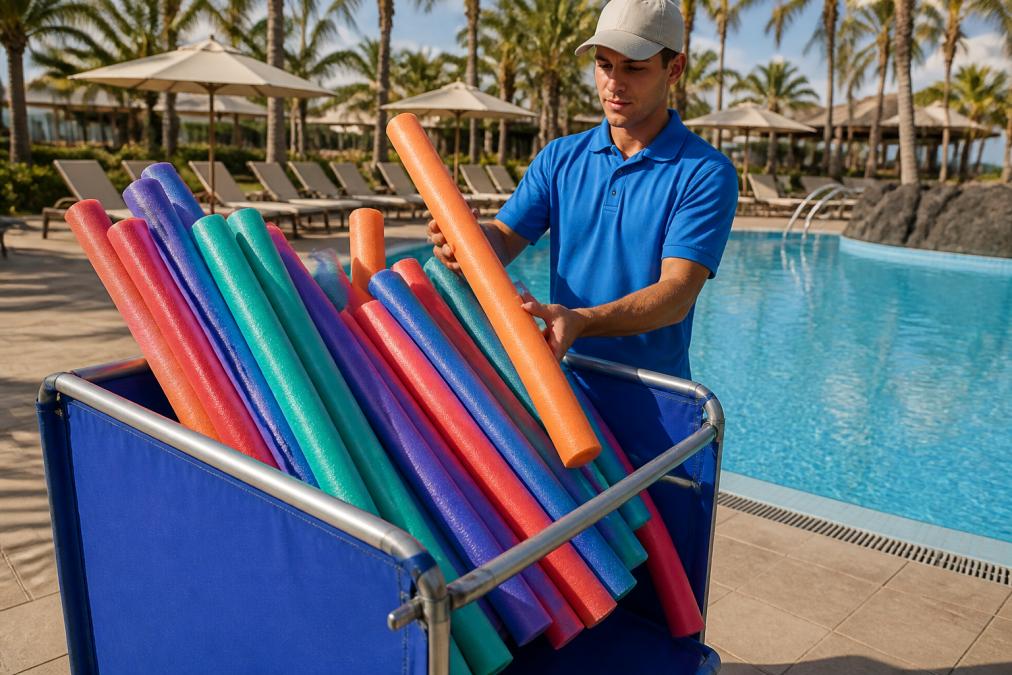
Each noodle measures approximately 48 inches in length and 2.5 inches in diameter with a 1-inch hollow core. The assorted pack includes purple, red, blue, orange, yellow, and green for a vibrant, cohesive look without multiple orders.
For properties that prefer a single color for branding or themed areas, FoamNoodles offers dedicated single-color 12-count packs in every standard color, all at the same $48.99 price point with the same free shipping terms.
Comparing Foam Types: Polyethylene Foam Roll vs. Pool Noodles
Understanding the difference between polyethylene foam roll stock and pool noodles helps procurement managers select the right material for each application. These are not interchangeable products; they serve different functions across a resort property.
Polyethylene foam roll is a closed-cell material sold in continuous sheets or rolls. It resists water absorption, provides excellent cushioning, and is commonly used for pipe insulation, backer rods, and protective padding. For resorts, polyethylene foam roll stock supports applications like edge protection on pool structures, gym matting underlays, and vibration dampening for equipment.
Pool noodles are extruded polyethylene foam tubes with a hollow core. Their cylindrical shape and buoyancy make them ideal for aquatic recreation, but their utility extends well beyond the pool. Resorts use them for floatation devices, craft projects, obstacle courses, and even as inexpensive bumpers on boat docks.
| Property | Polyethylene Foam Roll | Pool Noodles |
|---|---|---|
| Structure | Flat sheets or rolls | Hollow cylindrical tubes |
| Primary use | Insulation, padding, backer rods | Aquatic recreation, floatation |
| Water resistance | Closed-cell, resists absorption | Closed-cell, buoyant |
| Typical length | Continuous rolls | 48 inches standard |
| Best for resorts | Pipe insulation, edge guards | Pool toys, craft projects |
Maintenance and Longevity in High-Traffic Resort Environments
Resort foam products face a unique combination of stressors: constant sun exposure, chlorine or salt water, heavy guest use, and seasonal storage. Understanding how these materials degrade helps procurement managers choose products that last and plan for replacement cycles.
Ultraviolet (UV) degradation is the primary enemy of polyethylene foam. Prolonged sun exposure breaks down the polymer structure, causing brittleness, fading, and cracking. A noodle left on an uncovered deck for a full summer will show visible degradation by August, a cosmetic issue first, but a safety issue when the foam crumbles and sheds particles.
Chlorine and salt water accelerate surface breakdown. While closed-cell polyethylene does not absorb water, pool chemicals still attack the surface over time. Noodles that spend their entire season in the water degrade faster than those retrieved nightly, which is why many resorts rotate stock to allow drying and recovery.
Compression set is the silent killer of foam cushions. In high-traffic lounge areas, cushions are repeatedly compressed and left under stackable chairs overnight, losing their ability to spring back. Measured as the percentage of original thickness permanently lost, a quality hospitality-grade foam should show less than 10% compression set after extended testing.
Practical Longevity Guidelines for Resort Procurement
Establish a seasonal rotation schedule. Plan on a two-year replacement cycle for standard-use areas and a one-year cycle for high-use zones. Label each batch with its purchase date using a permanent marker on the end cap, so your team can identify second-season noodles and prioritize them for craft projects or giveaways rather than guest use.
Implement a nightly retrieval and rinse protocol. Noodles left floating overnight accumulate chemical residue and UV exposure. A simple cart retrieval at closing, followed by a fresh-water rinse and shaded storage, can extend useful life by 30% or more, the same applies to pool floats and lounger cushions.
Store foam flat in a climate-controlled space during off-season. Extreme temperature swings cause polyethylene to become brittle, and noodles stored standing on end in a hot shed will develop a permanent bend. Flat stacking in a cool, dry area with minimal weight preserves shape and flexibility.
For upholstered cushions, specify a higher density than you think you need. The cost difference between 1.8-pound and 2.2-pound density foam is modest at bulk scale, but the durability difference is substantial, a 2.2-pound cushion in a covered lounge can last five to seven years with regular rotation, while a 1.5-pound cushion may need replacement in two to three.
Track replacement costs against procurement savings. A cheaper foam product needing replacement every two years is rarely better value than a premium product lasting five. Calculate total cost of ownership, purchase price plus replacement labor plus guest experience impact, before deciding. Most resort managers find the premium for higher-density foam pays for itself within the first replacement cycle.
Frequently Asked Questions
What factors should resorts consider when choosing a bulk foam supplier?
Resorts should prioritize material quality, consistency, and logistics. Look for suppliers that provide detailed specifications like foam density and ILD ratings, as these determine durability for high-traffic areas. Verify lead times and shipping methods to ensure products arrive undamaged and on schedule. Also, confirm compliance with relevant fire safety standards for furniture foam and toy safety standards for children's products. A supplier with transparent procurement processes and responsive customer service simplifies reordering and helps maintain consistent quality across large orders.
What is the difference between polyurethane and polyethylene foam for commercial use?
Polyurethane foam is soft and flexible, making it ideal for cushions, mattresses, and upholstery where comfort is the priority. It compresses under weight and is commonly used in hospitality furniture. Polyethylene foam, often sold as a roll, is a closed-cell material that resists moisture and chemicals. It provides structural support and is better suited for flotation devices, packaging, and outdoor applications. Choosing between them depends on the use case: comfort applications call for polyurethane, while durability and water resistance call for polyethylene.
How can I ensure consistent foam density across large orders?
Request the foam density and indentation load deflection (ILD) rating in writing for every batch. A reliable supplier will provide these specifications without hesitation. Ask if they source from the same manufacturer for each production run, as raw material changes can alter firmness. For critical orders, request a sample from the actual batch before full production. Establish a quality check process at delivery, measuring dimensions and testing firmness on a few units from different boxes to catch any inconsistencies early.
Are there specific fire safety standards for foam used in hospitality furniture?
Yes. Upholstered furniture must meet flammability requirements that vary by state and local jurisdiction. Many commercial buyers across the country adopt specific standards as a baseline for hospitality procurement. When sourcing bulk foam for resort furniture, ask suppliers for a certificate of compliance and verify the foam's fire-retardant properties. This documentation is critical for liability and insurance purposes, so keep it on file for every order.