

Table of Contents
- What Counts as a Foam Alternative for DIY Crafts
- Quick Comparison: Affordable Foam Alternatives by Cost and Use
- Backer Rods as Foam Alternatives for Props and Padding
- How to Shape Foam for Cosplay Armor
- DIY Cosplay Armor Materials: Choosing Between Foam Types
- Reusable and Biodegradable Supports for Floral and Event Work
- Durability Testing: How Long Foam Alternatives Last
- Cost Breakdown and Bulk Buying Tips
- Frequently Asked Questions
Last Updated: September 17, 2026
What Counts as a Foam Alternative for DIY Crafts
A foam alternative is any material that replaces traditional expanding urethane or rigid foam sheets while matching a project's need for structure, padding, or shape. This guide from FoamNoodles breaks down the affordable options that hold up, from backer rods to recycled cotton and natural moss.
Quick Comparison: Affordable Foam Alternatives by Cost and Use
| Material | Typical Cost | Best For | Reusable? | Durability |
|---|---|---|---|---|
| Solid backer rod | $16.99-$47.99 | Props, padding, gap filling | Yes | High |
| Polyethylene sheet roll | $149.99-$879.99 | Armor, case inserts, mats | Yes | Very high |
| Pre-cut foam spirals | $28.99 | Decor, costume trim | Yes | Medium |
| Foam craft sticks | $19.99-$27.99 | Class projects, small props | Yes | Medium |
| Noodle bits | $14.99 | Filler, play, mosaics | Yes | Medium |
| Natural moss and cotton | Varies by craft store | Floral bases, biodegradable builds | Sometimes | Low to medium |
Bulk rolls cost more upfront but drop your per-project cost sharply after one or two builds.

Backer Rods as Foam Alternatives for Props and Padding
Backer rod is the sleeper pick: a closed-cell polyethylene tube sold for sealing expansion joints, so it's cheap, moisture resistant, and holds shape under compression.
Weight-Bearing Limits of Solid Backer Rod
Solid closed-cell rod handles light structural loads: weapon cores, padded edges, armor trim. It is not a load-bearing beam. For anything over a few pounds of sustained stress, step up to a polyethylene sheet roll laminated in layers.

How to Shape Foam for Cosplay Armor
Shaping foam for cosplay armor comes down to three moves: cut the base shape, heat-form the curve, then seal before painting. It's mostly about heat control, not tool cost.
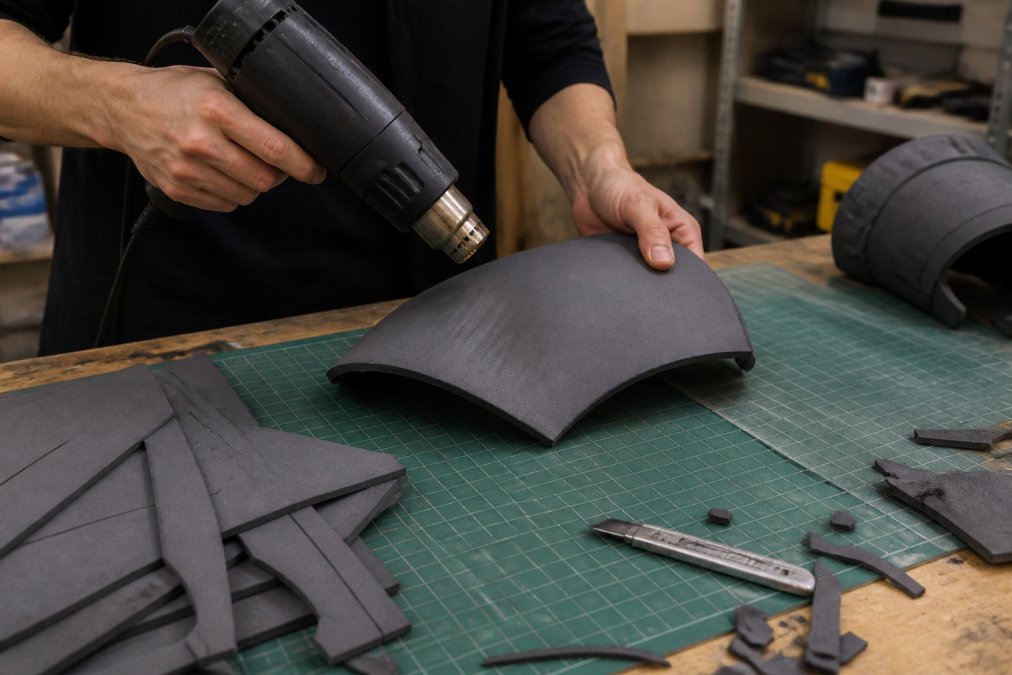
Here's the sequence that works:
- Trace your pattern onto the foam with a marker
- Cut slightly outside the line with a sharp hobby knife
- Warm the piece with a heat gun until it goes flexible, not glossy
- Press it over a curved form and hold until cool
- Seal with plasti dip or flexible primer before painting
Heat Forming and Cutting Techniques
Closed-cell polyethylene softens without melting at moderate temperatures. Keep the gun moving, hold it 6 to 8 inches away, and stop the moment the surface turns shiny. Beveled 45-degree cuts give cleaner seams on curved armor plates than straight cuts.
DIY Cosplay Armor Materials: Choosing Between Foam Types
DIY cosplay armor materials fall into two camps: closed-cell polyethylene for structure and flexible foam for comfort layers. Pick based on how the piece will be worn, not how it looks on the bench.
Adhesive and Compatibility Guide
Contact cement bonds polyethylene to itself and most plastics. Hot glue works for quick mockups but fails under flex. For foam-to-fabric joins, use a flexible fabric adhesive, not rigid epoxy, or the seam cracks the first time the piece bends.
Reusable and Biodegradable Supports for Floral and Event Work
Floral mechanics have moved past single-use foam blocks. Reusable supports like flower frogs, chicken wire cages, and natural moss bases hold arrangements just as firmly and last for years. Match the mechanic to the arrangement type: a frog that anchors a tight centerpiece won't hold a sprawling installation.
- Pin frogs (metal or ceramic): Best for dense, low centerpieces and bud vases. The weighted base holds stems upright without a cage. Reusable indefinitely if you rinse and dry after each event.
- Chicken wire cages: Best for medium-to-large arrangements where you need to build volume. Crumple the wire into a loose ball, tuck it into the vessel, and let the mesh grip each stem. Reusable for years; replace when the wire kinks or rusts.
- Natural moss bases: Best for biodegradable builds and installations where the base is visible. Packed sphagnum or sheet moss holds moisture and supports stems, then composts after the event.
- Recycled cotton and wool batting: Best as a moisture-retaining wrap around a cage or frog. It breaks down after use and avoids the microplastic shedding associated with traditional floral foam.
- Sand, gravel, and pebble fills: Best for weighted, low-profile arrangements. Inert, reusable, and cheap, but heavy and hard on delicate stems.
Building a Reusable Moss and Wire Base
The most versatile reusable base is a wire cage lined with moss. Here is the sequence that works:
Oodles of Noodles 5/8” × 20 ft Foam →
- Cut chicken wire to roughly twice the width of your vessel.
- Crumple it into a loose ball and press it into the vessel so the top sits just below the rim.
- Line the inside of the cage with a layer of sheet moss, green side out.
- Add a thin layer of recycled cotton batting over the moss to hold moisture.
- Insert stems through the wire mesh, angling them to follow the shape you want.
Biodegradable Options and Waste Reduction
Biodegradable mechanics matter more than ever for event work, where waste reduction is often a client requirement. Recycled cotton and natural moss both break down after use, and neither leaches the microplastics that traditional floral foam does. The U.S. Environmental Protection Agency information on reducing waste at events outlines why compostable mechanics are gaining traction with venues.
Durability Testing: How Long Foam Alternatives Last
Real durability testing is simple: build a test piece, stress it the way the final project will be stressed, and check it after a week, a month, and a year. Foam that passes the bench test often fails the wear test, which is why so many DIYers are surprised when a prop or base gives out mid-season.
- Backer rod: Maintains shape over years indoors. UV exposure yellows and eventually embrittles the surface outdoors, so seal or paint any piece that lives in sunlight. Compression recovery stays strong as long as the rod is not stored under a permanent load.
- Polyethylene sheet: Resists mildew, mold, rot, and bacteria, making it the strongest long-term option for armor and case inserts. Heat-formed curves can slowly relax if the piece is stored warm and flat; store finished armor on a form or hanging to hold the shape.
- Pre-cut spirals: Good for one or two seasons, then the color fades and the cell structure softens. Keep them out of direct sun and heat to stretch the second season.
- Natural moss: Composts within a season, by design. In humid rooms it can mold before it dries out, so refresh it rather than trying to preserve it.
- Recycled cotton: Holds up for repeated event use if kept dry. Once it stays damp, it mats down and loses loft, and no amount of drying brings it back.
Testing Your Build Before You Commit
A short stress test catches most failures before they reach a convention or an event. Run these three checks on a scrap or a test piece:
- Flex test: Bend the piece the way it will bend when worn or handled. Watch the seam, not the foam. If the adhesive cracks, the joint fails before the material does.
- Load test: Hang or press the weight the piece will actually carry for 24 hours. A sword core that sags overnight will sag worse after a weekend of handling.
- Environment test: Leave a sample in the conditions the piece will live in, such as a hot car, a humid venue, or direct sun. UV and heat are the two fastest killers of foam alternatives.
What Actually Fails First
Adhesive failure kills more projects than foam failure. A backer rod core outlasts the glue holding it to a hilt; a polyethylene plate outlasts the seam joining it to a strap. Test your glue on a scrap before committing a finished piece, and re-check seams after the first wear.
Cost Breakdown and Bulk Buying Tips
Bulk buying is where affordable foam alternatives get affordable. A single backer rod runs $16.99, but the per-foot cost drops hard once you buy rolls or multi-packs.
For a typical cosplay build, here's what to expect:
- Small props: one 20 ft backer rod roll at $16.99 covers most of a build
- Full armor set: a flat foam roll at $149.99 handles multiple pieces with material left over
- Classroom or event batch: an 8-pack of craft sticks at $27.99 or a bits box at $14.99 stretches across dozens of small projects
- Floral work: a pre-cut spiral 4-pack at $28.99 covers several arrangements
Frequently Asked Questions
What can I use instead of craft foam for DIY projects?
Solid foam backer rods, polyethylene foam rolls, and foam craft sticks all work as craft foam alternatives. Backer rods bend and cut easily for props, while flat foam rolls suit custom inserts and padding. FoamNoodles offers a 20-foot noodle rope for $16.99 and an 8-pack of craft sticks for $27.99, both of which handle modeling, decor, and gap-filling tasks that normally call for craft foam sheets.
How do I shape foam for cosplay armor without special tools?
A hobby knife, heat gun, and sandpaper cover most shaping needs. Cut the base shape first, then warm the foam until it bends, press it over a curved form, and hold until it cools. Backer rods and craft sticks respond well to heat and can be painted or glued after shaping. Practicing on scrap pieces before cutting final armor panels saves material.
What are the cheapest DIY foam alternatives for large projects?
Bulk backer rod rolls and noodle bits give the lowest cost per unit for large builds. FoamNoodles sells a pre-caulking filler rope roll for $159.99 and a bits box starting at $14.99. For high-volume work like event decor or classroom projects, buying in bulk cuts material costs compared to small retail packs, and free shipping on qualifying orders reduces the total further.
Are there eco-friendly alternatives to styrofoam for crafts?
Polyethylene foam backer rods and reusable foam sticks are more durable than styrofoam and can be reused across multiple projects. Natural moss and cellulose-based fillers also work for floral arrangements and decorative bases. Choosing reusable supports reduces waste because the same foam piece can serve several builds before it needs replacing.