

Table of Contents
- What Is a Backer Rod and Why It Matters for Sealant Performance
- Closed Cell vs Open Cell Backer Rod: Which Type Do You Need?
- Backer Rod Size Chart: Matching Diameter to Joint Width
- Common Applications: Expansion Joints, Perimeter Sealing, and More
- How to Install Backer Rod in 6 Steps
- Troubleshooting Failed Sealant Joints
- DIY vs. Professional-Grade Backer Rod: What's the Real Difference?
- Conclusion
Last Updated: August 28, 2026
What Is a Backer Rod and Why It Matters for Sealant Performance
A backer rod is a compressible, cylindrical foam insert placed into joints and gaps before sealant is applied, controlling the depth of the sealant and preventing it from bonding to the bottom of the joint. The most common problem: sealant fails within months because backer rod is missing or improperly sized.

Sealant is designed to flex. When a joint moves from thermal expansion, building settlement, or moisture cycling, the sealant must stretch and compress without tearing. If the sealant bonds to three surfaces (both joint walls and the bottom), it cannot flex properly. That three-sided adhesion creates stress concentrations that cause premature cracking and failure.
A properly installed backer rod solves this by acting as a bond breaker, preventing the sealant from adhering to the back of the joint, and controlling joint depth to ensure the correct width-to-depth ratio for maximum elongation and tensile strength. According to guidance from the American Concrete Institute, proper sealant depth-to-width ratios are critical for joint longevity in concrete masonry applications. The result is a sealant joint that moves with the structure instead of fighting it.
Closed Cell vs Open Cell Backer Rod: Which Type Do You Need?
The type of backer rod you choose changes the performance of your entire joint system. Getting this wrong is one of the most common, and most expensive, mistakes in sealing work.
Closed-Cell Polyethylene Foam
Closed-cell backer rod is made from extruded polyethylene foam with a non-porous, moisture-resistant skin. The cells are sealed, meaning the material does not absorb water, off-gas, or compress unevenly under sealant pressure.
This is the right choice for expansion joints in concrete floors and walls, perimeter sealing around windows and doors, highway joints and parking garage joints, high-moisture environments including below-grade and exterior applications, and any joint requiring a self-leveling sealant. The non-stick skin means sealants will not adhere to the backer rod surface, so no separate bond breaker tape is required.
FoamNoodles carries the FILL-RITE Pre-Caulking Filler Rope Backer Rod in closed-cell polyethylene, available in seven diameters from 1/4" to 1-1/4" as a bulk roll option, and in a 5-inch diameter for large commercial joints.
Open-Cell (Soft) Foam
Open-cell backer rod has a more porous structure and compresses more easily, conforming to irregular joint shapes that a rigid closed-cell rod would bridge over. Use open-cell when the joint has an irregular or V-shaped profile, the substrate is uneven concrete masonry or rough-cut stone, you're working with acrylic, butyl, or polysulfide sealants that require a breathable backing, or the joint is non-horizontal and a self-leveling sealant is not used.
One important limitation: open-cell foam can absorb moisture if the sealant skin is breached. For below-grade or continuously wet environments, closed-cell is the safer long-term choice.
FoamNoodles offers soft-type backer rod in 3/8", 5/8", 7/8", and 1-1/8" sizes for smaller-scale work where irregular joint profiles are common.

Backer Rod Size Chart: Matching Diameter to Joint Width
Choosing the wrong diameter is the single most common installation error. Too small and the backer rod falls into the joint or doesn't hold position. Too large and you can't seat it to the correct depth without distorting the foam.

The standard rule: select a backer rod diameter that is 25% to 33% larger than the joint width. This creates a compression fit that holds the rod in place without a fastener and ensures consistent contact with both joint walls.
| Joint Width | Recommended Backer Rod Diameter | Available at FoamNoodles |
|---|---|---|
| 3/16" | 1/4" | Yes |
| 5/16" | 3/8" | Yes |
| 3/8" - 7/16" | 1/2" | Yes |
| 1/2" - 9/16" | 5/8" | Yes |
| 5/8" - 3/4" | 3/4" | Yes |
| 3/4" - 7/8" | 1" | Yes (bulk roll) |
| 1" - 1-1/8" | 1-1/4" | Yes (bulk roll) |
| 4" - 5" | 5" | Yes (commercial carton) |
Sealant depth should be roughly half the joint width, with a minimum of 1/4" and a maximum of 1/2" for most cold-applied sealants. The backer rod controls this depth by sitting at the correct elevation in the joint.
Common Applications: Expansion Joints, Perimeter Sealing, and More
Backer rod is used wherever a sealant joint must accommodate movement, resist moisture, or maintain consistent depth. Concrete and masonry expansion joints are the most common use case, concrete expands and contracts with temperature changes, and expansion joints are designed to absorb that movement. Without a backer rod controlling sealant depth, the sealant becomes too thick, loses flexibility, and cracks under joint movement.
Perimeter sealing around windows, doors, and curtain walls requires backer rod to fill the void between the frame and the rough opening before sealant is applied. This prevents sealant waste, controls depth, and ensures the joint can flex as the building moves.
Other common applications include parking garage deck joints, highway and bridge expansion joints, pre-cast concrete panel joints, glazing installation and storefront framing, pipe penetrations through walls and floors, and tilt-up construction perimeter joints.
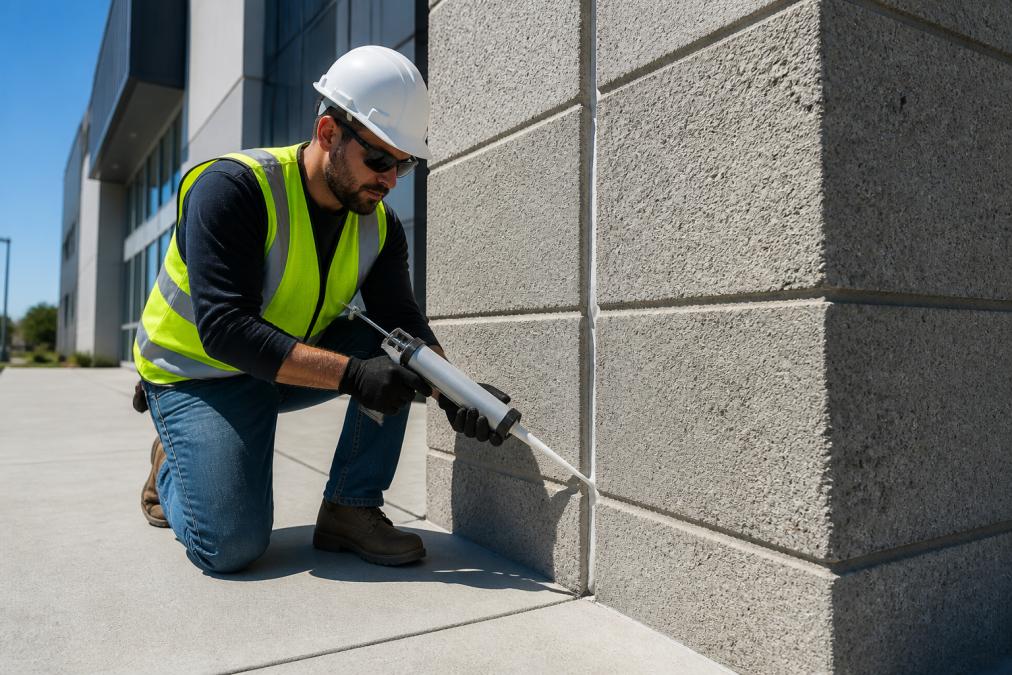
According to the Portland Cement Association's guidance on joint sealants, back-up material like backer rod is a required component of any properly designed sealant joint in concrete construction.
How to Install Backer Rod in 6 Steps
Installing backer rod correctly takes less than ten minutes per joint once you know the process. The steps below apply to the most common scenario: a horizontal or vertical concrete expansion joint sealed with a cold-applied sealant.
Tools and Materials You'll Need
- Backer rod (correct diameter for your joint width)
- Blunt-edged installation tool (a wooden dowel, roller, or specialized backer rod wheel)
- Wire brush or compressed air for joint cleaning
- Caulk gun loaded with your chosen sealant
- Tuck pointer or putty knife for sealant tooling
- Measuring tape
Avoid sharp tools. A screwdriver or awl will puncture closed-cell backer rod, destroying the non-stick skin and compromising the compression fit.
Step-by-Step Installation
Step 1: Clean the joint thoroughly. Remove all dust, debris, old sealant, and loose aggregate using a wire brush and compressed air. Sealant adhesion depends entirely on a clean, dry substrate.
Step 2: Measure joint width and depth. Confirm the joint dimensions before selecting your backer rod. Joint width determines rod diameter; joint depth determines how deep the rod needs to sit to achieve the correct sealant depth.
Step 3: Select and cut the backer rod. Choose a rod diameter 25-33% larger than the joint width. Cut to length with scissors; do not stretch or force the rod into a joint it's too small for.
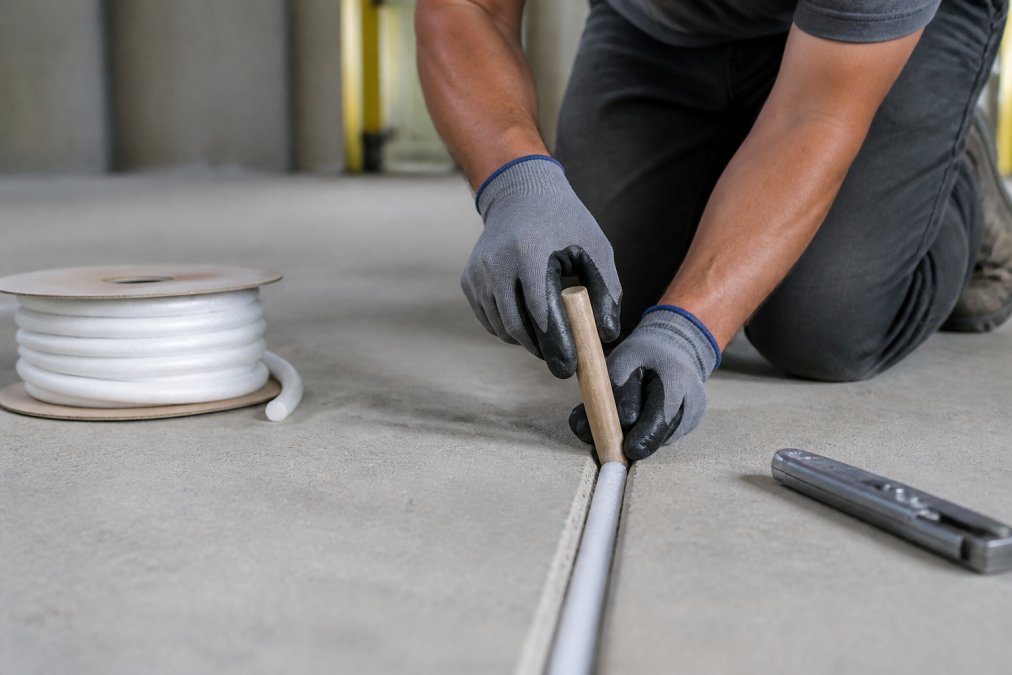
Step 4: Press the backer rod into the joint. Use a blunt tool to push the rod to the correct depth. The rod should sit below the surface by an amount equal to the desired sealant thickness, typically 1/4" to 1/2" below the surface plane.
Step 5: Apply sealant. Load your caulk gun and apply sealant in a continuous bead, filling the joint from the bottom up. The backer rod acts as the floor of the sealant cavity. Do not leave voids or air pockets.
Step 6: Tool the sealant surface. Use a tuck pointer or wet finger to smooth and slightly concave the sealant surface. This improves adhesion at the joint edges and promotes proper curing. Allow full curing time before the joint is exposed to movement or moisture.
Troubleshooting Failed Sealant Joints
A sealant joint that cracks, debonds, or tears within the first year is almost always a backer rod problem, either missing, wrong size, or wrong type.
Sealant cracking along the center indicates three-sided adhesion. The sealant bonded to the back of the joint and couldn't flex. Solution: remove the failed sealant, install the correct backer rod, and reseal.
Sealant pulling away from one wall is usually a surface preparation issue, contamination, or moisture. However, if the sealant is too deep (no backer rod), the sealant mass is too thick to flex, creating uneven stress and eventual debonding.
Backer rod visible at the surface means the rod was not seated deep enough. The sealant layer is too thin and will fail under UV exposure and joint movement. Remove the sealant, re-seat the rod, and reseal.
Backer rod sinking into the joint indicates the rod diameter was too small for the joint width. It lost its compression fit and dropped. Use the sizing chart and select the next diameter up.
Sealant bubbling during cure can occur with open-cell backer rod if the foam absorbs solvent from the sealant. Switch to closed-cell backer rod, which is inert and will not react with sealant chemistry.
As noted by ASTM International's standards for joint sealants, proper back-up material selection is a foundational requirement for sealant joint longevity in both residential and commercial construction.
DIY vs. Professional-Grade Backer Rod: What's the Real Difference?
Most people assume professional-grade materials are just the same product in bigger packages. For backer rod, that's mostly true, but there are a few distinctions worth knowing.
Diameter range. DIY-oriented products typically cover common residential sizes: 1/4" through 3/4". Professional-grade products extend into larger diameters, 1", 1-1/4", 5", and beyond, for commercial expansion joints, highway joints, and large-format construction.
Length per roll. A small-quantity retail backer rod might come in a 20-foot roll. A commercial bulk roll might be 500 feet. For a single window or door, the short roll is fine. For a commercial building perimeter or parking deck, bulk purchasing is the only practical option.
Material consistency. Professional-grade closed-cell backer rod is manufactured to tighter tolerances for diameter consistency and skin integrity. For critical joints, that consistency matters. For residential work, standard product performs reliably.
Cost per linear foot. Bulk purchasing drops the per-foot cost substantially. The FoamNoodles FILL-RITE bulk roll in 1/4" diameter covers 500 feet, working out to a fraction of the per-foot cost of short retail lengths.
For most DIY projects, small-quantity backer rod is the right call. For contractors, property managers, or anyone running large volumes of joint work, bulk closed-cell backer rod is the better investment.
| Feature | DIY / Small Quantity | Professional / Bulk |
|---|---|---|
| Diameter range | 1/4" - 3/4" | 1/4" - 5" and above |
| Roll length | 20' - 130' | 230' - 500' |
| Best for | Single joints, home repair | Commercial projects, contractors |
| Cost per foot | Higher | Lower |
| Material grade | Standard | Consistent tolerances |
FoamNoodles carries both options: small-quantity backer rod starting at $28.99 for soft-type and $30.99 for closed-cell, and the FILL-RITE bulk roll at $159.99 for contractors who need volume. The 5-inch commercial closed-cell rod is available in a 15-piece carton for large-format joint work.
Getting sealant joints right the first time requires more than a good caulk gun and steady hands. Without the correct backer rod seated at the right depth, even premium sealants fail prematurely. FoamNoodles offers closed-cell and soft-type backer rod across the full range of residential and commercial sizes, with bulk roll options for high-volume projects and fast shipping so your job doesn't wait. View All backer rod options at FoamNoodles and get the right back-up material for your next joint.
Frequently Asked Questions
What is a backer rod used for?
A backer rod is a compressible foam cylinder pressed into a joint or gap before sealant is applied. It controls the depth of the sealant, prevents three-sided adhesion, and creates the correct hourglass shape that allows the cured sealant to flex with joint movement. Without it, sealant bonds to the back wall of the joint and tears under stress. Backer rods are used in concrete expansion joints, window perimeters, door frames, parking structures, and anywhere a flexible sealant seal is required.
Do you caulk over a backer rod?
Yes. The backer rod goes in first, then caulk or sealant is applied on top of it. The rod acts as a back-up material that stops the sealant from sinking too deep into the joint. The correct sealant depth is typically half the joint width, and the backer rod sets that depth automatically. Most closed-cell polyethylene backer rods are non-stick, so no bond breaker is needed before applying cold-applied sealants like urethane, silicone, or acrylic.
How do you determine the correct backer rod size for a joint?
Choose a backer rod diameter 25% to 50% wider than the joint opening. For example, a 1/2-inch-wide joint calls for a 5/8-inch or 3/4-inch diameter rod. The oversize fit creates a compression fit that holds the rod securely without adhesive. Sealant depth should equal half the joint width, with a minimum of 1/4 inch. If the joint is irregular or v-shaped, a soft open-cell backer rod conforms better than a rigid closed-cell option.
What are the most common mistakes when using a backer rod?
The three most common mistakes are: using a rod that is the same diameter as the joint (it will fall through instead of gripping), setting the rod too deep and leaving too thick a sealant layer (which restricts movement and causes tearing), and puncturing or stretching a closed-cell rod during installation (which destroys its moisture-resistant skin and reduces joint performance). Always use a blunt tuck pointer or roller to seat the rod, never a sharp tool.
This article was written using GrandRanker