

Table of Contents
- Quick Comparison: Best Foam Backer Rods for Concrete
- How We Evaluated These Backer Rods
- 1. FILL-RITE Pre-Caulking Filler Rope Backer Rod Roll Bulk: Best Overall Value
- 2. Small-Quantity Backer Rods: Best for Small Concrete Projects
- 3. Small-Quantity Soft Foam Backer Rods: Best for Irregular Joint Widths
- 4. FILL-RITE 2" x 72" Foam Backer Rod 4 Pack: Best for Wide Concrete Gaps
- Backer Rod Size Chart: Matching Rod Diameter to Joint Width
- How to Install Backer Rod in Concrete: Step-by-Step
- Frequently Asked Questions
Last Updated: September 21, 2026
Quick Comparison: Best Foam Backer Rods for Concrete
The best foam backer rods for concrete balance diameter accuracy, compression recovery, and price per foot. FoamNoodles carries the full range, from 1/4-inch glazing rods to 4-inch expansion joint filler, all made from closed-cell polyethylene that sealants won't stick to.
Here's how the top picks compare:
| Product | Sizes | Price | Best For |
|---|---|---|---|
| FILL-RITE Pre-Caulking Filler Rope Roll | 1/4" to 1-1/4" | $159.99 | Large jobs, best value per foot |
| Small-Quantity Backer Rods | 1/4" to 3/4" | $30.99 | Small concrete projects |
| Small-Quantity Soft Foam Rods | 3/8" to 1-1/8" | $28.99 | Irregular, varying joint widths |
| FILL-RITE 2" x 72" 4 Pack | 2" | $33.99 | Wide concrete gaps |
A backer rod is a compressible foam rope that fills a concrete joint before you apply sealant, controlling how deep the sealant sits.

How We Evaluated These Backer Rods
We judged each product on five factors: diameter range, compression recovery, sealant compatibility, length per dollar, and how well the rod holds its shape once seated. Compression recovery matters most, a rod that stays compressed leaves a gap under the sealant, and that gap becomes a leak.
1. FILL-RITE Pre-Caulking Filler Rope Backer Rod Roll Bulk: Best Overall Value
For anyone sealing more than a few joints, this is the pick. It comes in seven diameters, from 1/4 inch to 1-1/4 inch, and the bulk roll drops your cost per foot well below individual packs.
Specs worth knowing:
- Density: 1.3-1.9 lbs/ft3
- Compression recovery: over 90%
- Temperature range: -90°F to 190°F
- Meets ASTM D5249 Type 3 and ASTM C1330 Type C
2. Small-Quantity Backer Rods: Best for Small Concrete Projects
The biggest mistake DIYers make is buying a 500-foot roll for a single expansion joint. This option solves that: same closed-cell polyethylene construction as the bulk roll, sold in smaller lengths.
3. Small-Quantity Soft Foam Backer Rods: Best for Irregular Joint Widths
Concrete joints aren't always uniform. Old slabs shift, and widths can wander from 3/8 inch to over an inch along a single run. Standard closed-cell rod can't compress evenly; this soft, bi-cellular rod can.
4. FILL-RITE 2" x 72" Foam Backer Rod 4 Pack: Best for Wide Concrete Gaps
Wide joints need a rod that won't collapse under sealant weight. This 2-inch closed-cell rod handles expansion joints, highway joints, and parking deck gaps where smaller diameters sink.
Backer Rod Size Chart: Matching Rod Diameter to Joint Width
The rule of thumb: pick a rod roughly 25% wider than the joint. Too thin and it won't stay seated; too thick and it won't fit without over-compressing.
| Joint Width | Backer Rod Diameter | Typical Use |
|---|---|---|
| 1/4" | 3/8" | Glazing, tight seams |
| 3/8" | 1/2" | Window and door joints |
| 1/2" | 5/8" | Driveways, patios |
| 5/8" | 3/4" | Sidewalks, curbs |
| 3/4" | 1" | Parking decks |
| 1" | 1-1/4" | Expansion joints |
| 1-1/2" | 2" | Highway joints, wide gaps |
Why the 25% Rule Exists
A backer rod is a compression-fit part, not a filler. It must press against both joint walls hard enough to stay put while the sealant cures and the joint opens and closes through the seasons.

How to Measure a Concrete Joint in the Field
Joint width is rarely one number. Old slabs shift, saw cuts wander, and freeze-thaw cycles open and close the gap. Measure at three points along every run:
FILL-RITE Pre-Caulking Filler Rope →
- Both ends of the joint, right where the sealant will start and stop.
- The midpoint, or the narrowest visible section.
- Any obvious wide spot, usually where a slab has tilted or a corner has spalled.
Irregular and Oversized Joints
When joint width wanders, standard closed-cell rod can't compress unevenly without leaving gaps. Two options work:
- Soft, bi-cellular rod. It installs between 25% and 50% compression and adapts as the width changes. Size it to the widest point and let it compress into the narrow spots.
- Split the run. Seal the uniform sections with standard rod, then handle the irregular stretch separately with soft rod. This avoids over-compressing a rigid rod just to reach a wide spot.
Depth, Not Just Width
Diameter controls fit; depth controls sealant shape. The rod's real job is holding the sealant at the right thickness so it can stretch and compress without tearing.
How to Install Backer Rod in Concrete: Step-by-Step
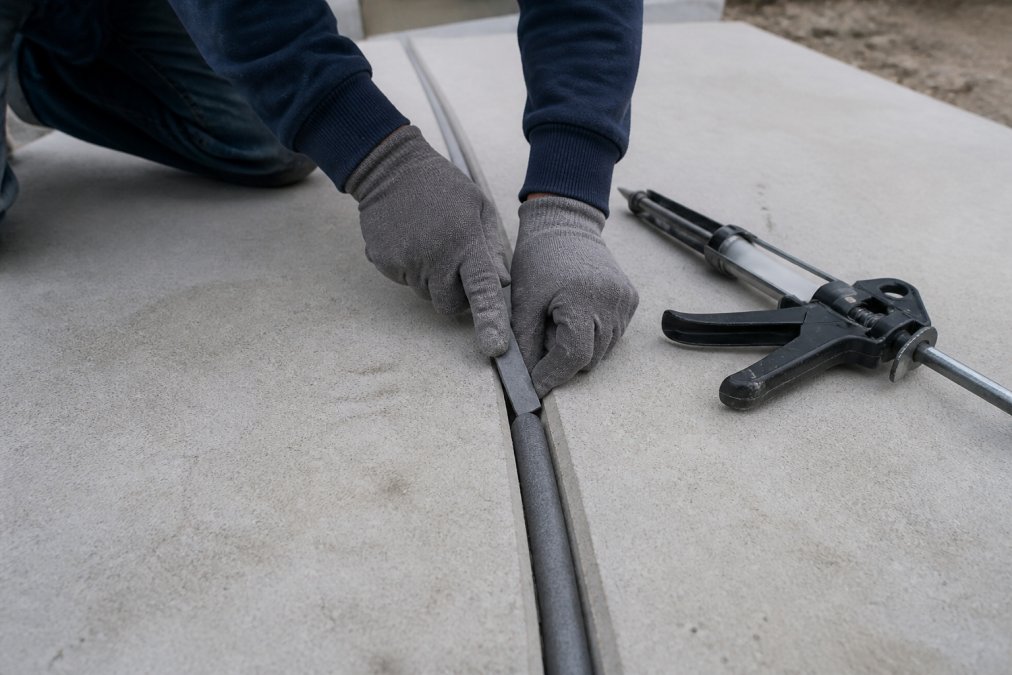
- Clean the joint. Remove dirt, loose concrete, old sealant, and any curing compounds or form-release agents. The joint must be dry and free of frost.
- Measure the width. Check the joint at several points and note the widest measurement.
- Select the rod size. Match a rod about 25% wider than the joint. Use the size chart above.
- Seat the rod. Push it in with a roller or blunt, flat-sided tool. Don't fold, stretch, or puncture it.
- Set the depth. Follow your sealant manufacturer's recommended width-to-depth ratio. The rod controls this.
- Apply sealant. Fill the joint so the sealant bonds to the concrete sides, not the rod. This three-sided adhesion is what lets the sealant stretch and compress with the joint.
Temperature and Weather: When Not to Install
Foam backer rod and sealant both behave differently outside a moderate temperature window, where many DIY joints fail within the first year.
- Cold joints. Below roughly 40°F, many cold-applied sealants skin over slowly or not at all, and the concrete surface may hold frost or surface moisture that blocks adhesion. Rods also stiffen in the cold and resist seating evenly. If you must work cold, warm the rod indoors first and confirm your sealant's minimum application temperature on the label.
- Hot joints. On a sun-baked slab, surface temperatures can run well above air temperature. Sealant can skin over before you finish tooling, trapping air underneath. Work early in the day, in shade, or in sections you can tool before the skin forms.
- Wet or damp joints. Standing water, dew, or a recently washed slab will defeat the bond. The joint must be dry before the rod goes in and before the sealant goes on.
Common Installation Failures and How to Avoid Them
Most backer rod problems trace back to one of four mistakes. Each has a specific fix.
Puncturing the water-resistant outer skin defeats the purpose of a closed-cell rod. Once moisture gets inside, the rod can hold water against the joint. Seat it with a blunt tool, never a sharp one.
Tooling and Finish
After the sealant goes in, tool it once with a blunt tool or a tooling agent recommended by the sealant maker. Tooling presses the sealant against both walls and gives it a slight concave shape that helps it stretch instead of tearing. Don't over-tool, repeated dragging pulls sealant off the walls and thins the joint.
Installation is depth control plus compression fit. Size the rod up, seat it dry and deep, keep the sealant off the rod, and work inside the temperature window your sealant allows. Those four habits prevent nearly every backer rod failure.
Frequently Asked Questions
What is the recommended thickness for a backer rod?
Pick a foam backer rod about 25 percent wider than the joint. A 1/2-inch concrete joint takes a 5/8-inch rod. The rod should sit snugly in the gap and compress slightly, which keeps it in place while you apply sealant. FILL-RITE rods come in 1/4 inch through 4 inch diameters, so most concrete joints have a matching size without special ordering.
Can a backer rod be used on concrete?
Yes. Foam backer rods are made for concrete expansion joints, construction joints, pavement repairs, parking decks, and pool decks. They act as a depth control so sealant forms the right shape and bonds only to the joint walls. Closed-cell polyethylene rods like the FILL-RITE line are chemically inert, resist gasoline, oil, and most solvents, and won't stain or adhere to cold-applied sealants.
What are the common mistakes when using a backing rod?
The most frequent errors are choosing a rod that's too thin, which lets it fall out of the joint, and puncturing the water-resistant outer skin during installation. Punctures break the moisture barrier and let water into the joint. Other mistakes include over-stretching the rod, folding it into the gap, and seating it too shallow, which leaves too little room for sealant depth.
How do you determine the correct size backer rod for a joint?
Measure the joint width first, then choose a rod roughly 25 percent larger. A 3/4-inch joint calls for a 1-inch rod. For irregular or varying joint widths where standard closed-cell rods won't seat properly, soft foam backer rods in 3/8 inch to 1-1/8 inch sizes conform better. Always check the sealant manufacturer's recommended width-to-depth ratio before installing.
Why is a backer rod necessary before applying sealant?
Without a backer rod, sealant sinks to the bottom of the joint and bonds to three surfaces at once, a condition called three-sided adhesion. When the concrete expands and contracts, that bond tears the sealant. A backer rod controls sealant depth and forces the sealant to bond only to the two joint walls, so it can stretch and compress with the concrete instead of failing.