

Table of Contents
- Comparing Bulk Foam Packaging Methods at a Glance
- 1. Polyethylene Foam: Closed-Cell Protection for Heavy Shipments
- 2. Polyurethane Foam: Open-Cell Cushioning for Fragile Items
- 3. Foam-in-Place: In-Situ Packaging for High-Volume Operations
- 4. Custom Foam Inserts for Shipping: Precision Fit and Transit Safety
- 5. Protective Packaging Best Practices for Bulk Shippers
- 6. Cost, Storage, and Sustainability in Foam Packaging
- Step-by-Step: Applying Bulk Foam Packaging Methods
- Frequently Asked Questions
Last Updated: September 14, 2026
Comparing Bulk Foam Packaging Methods at a Glance
Choosing the right bulk foam packaging methods for shipping comes down to matching material structure to what you're actually protecting. This guide from FoamNoodles breaks down the four main approaches so you can pick the right one without overbuying or under-protecting. The stakes are real: a cracked item costs you the product, the shipping, and often the customer.
Foam packaging falls into two structural families: closed-cell and open-cell. Closed-cell foams like polyethylene resist moisture and bounce back after impact. Open-cell foams like polyurethane absorb energy by compressing. Neither is universally better. The right choice depends on weight, fragility, and volume.
Here's the quick comparison before we go deep on each method.
| Method | Best For | Protection Type | Reusability |
|---|---|---|---|
| Polyethylene foam | Heavy, durable goods | Impact resistance | High |
| Polyurethane foam | Fragile, lightweight items | Shock absorption | Low |
| Foam-in-place | High-volume operations | Custom-fit cushioning | None |
| Custom foam inserts | Precision equipment | Vibration dampening | High |
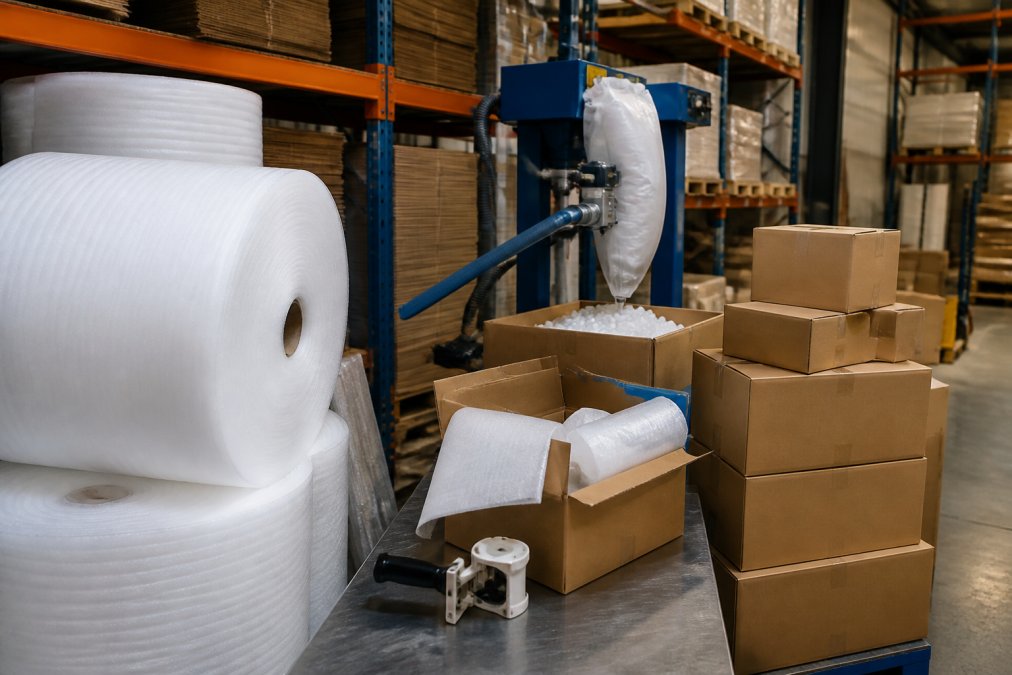
1. Polyethylene Foam: Closed-Cell Protection for Heavy Shipments
Polyethylene foam is a closed-cell material that holds its shape under repeated impact, making it the workhorse for bulk shipping operations moving heavy or moderately fragile goods. Its sealed cell structure blocks moisture and resists compression set, so a roll that arrives flat stays flat.
The material cuts easily with a razor knife, which means your packing team can size pieces on the fly without special equipment. For operations that ship a consistent mix of box sizes, that flexibility reduces the number of SKUs you need to stock.
Pros and Cons of Polyethylene Foam
Pros:
- Closed-cell structure resists water and vapor
- Recovers shape after impact
- Easy to cut and shape on site
- Available in rolls and sheets for bulk use
Cons:
- Higher cost per cubic foot than loose fill
- Less conforming around irregular shapes than foam-in-place
- Takes up more warehouse space than compressed alternatives
2. Polyurethane Foam: Open-Cell Cushioning for Fragile Items
Polyurethane foam is an open-cell material that cushions fragile items by compressing on impact, spreading the force across a wider area. It's the better pick when the item matters more than the box.
Open-cell foam breathes, which helps with items that trap heat or moisture (pubmed.ncbi.nlm.nih.gov). The trade-off is durability: it breaks down faster under repeated stress than closed-cell foam, so it's a one-trip material in most shipping applications.
When Polyurethane Beats Polyethylene
Polyurethane wins when the item is light, irregularly shaped, or highly fragile. Electronics, glassware, and instruments benefit from the softer compression profile. Polyethylene wins when the item is heavy, has flat surfaces, or needs moisture resistance. If you ship both categories, stock both. Trying to force one material to do both jobs usually means under-protecting the fragile items.
3. Foam-in-Place: In-Situ Packaging for High-Volume Operations
Foam-in-place is a packaging method where two liquid components mix at the point of packing and expand to form a custom foam cushion around the item (pubmed.ncbi.nlm.nih.gov). It eliminates the guesswork of sizing inserts because the foam shapes itself to whatever it surrounds.
The method suits operations with high SKU variety or items that change shape between production runs. You gain a perfect fit every time and cut the labor of cutting and fitting pre-formed pieces. You also add equipment, training, and a chemical handling process to your workflow.
How Foam-in-Place Works
- A operator dispenses the two-part mixture into the box or bag
- The mixture begins expanding within seconds
- The item is placed into the expanding foam
- The foam cures around the item, locking it in position
- The box is sealed once the foam sets
Setup typically takes a few hours of training per operator. The real cost is the dispensing equipment and the ongoing material supply, which only pencils out at volume.
4. Custom Foam Inserts for Shipping: Precision Fit and Transit Safety
Custom foam inserts for shipping are pre-cut foam pieces shaped to match a specific product, giving you repeatable protection without on-the-fly cutting. For operations shipping the same item thousands of times, inserts remove variability from the packing process.
The payoff is consistency. Every box protects the item the same way, which matters when you're shipping precision equipment, medical devices, or anything where a single failure triggers a return and a support ticket. The cost is tooling: custom inserts require a die or cutting setup, so they only make sense when the volume justifies it.
For lower-volume needs, a flat foam roll lets you cut inserts by hand for the same effect without the tooling cost. FoamNoodles carries a Polyethylene Flat Foam Roll that works well for this, and we also stock a Master Roll Foam Sheet for operations that go through material faster.


5. Protective Packaging Best Practices for Bulk Shippers
Protective packaging best practices for bulk shippers come down to three things: match the foam to the item, eliminate void space, and standardize your process so every packer does it the same way. Most shipping damage traces back to a gap in one of those three. Precision in these protective measures becomes even more critical when shipping original artwork, where the unique dimensions and delicate surfaces demand a specialized approach to structural integrity.
Start by testing. Pack a sample order and drop it from the height your carrier's handling will subject it to. If the item survives, your configuration works. If it doesn't, add foam or change material before you scale.
Then standardize. Write down which foam goes with which product and how much. Packing errors drop when the decision is already made.
Choosing the Right Foam Density
Foam density measures how much material is packed into a given volume, and it directly affects load-bearing capacity and impact resistance (pubmed.ncbi.nlm.nih.gov). Higher density holds more weight and resists compression longer. Lower density cushions softer but compresses faster.
Match density to weight. Light items need lower density so the foam compresses and absorbs energy. Heavy items need higher density so the foam doesn't flatten under load. If you're unsure, test both and compare how the item survives.
6. Cost, Storage, and Sustainability in Foam Packaging
Cost, storage, and sustainability pull in different directions, so treat them as one operational equation rather than three separate decisions. The goal is the lowest total cost per protected unit shipped, not the lowest material price per cubic foot.
Storage and Warehouse Space Optimization
Bulk foam is mostly air, which means you pay for the volume it displaces whether it is protecting a product or sitting on a shelf. A few practical patterns separate efficient operations from crowded ones:
- Store vertically, not horizontally. Rolls stood on end in a rack use a fraction of the floor footprint that the same rolls consume when stacked flat on a pallet.
- Keep foam at the packing station, not in a central aisle. Every trip to retrieve material adds labor minutes that never show up on a material invoice.
- Match roll length to consumption rate. A 50-foot roll that lasts a week ties up less capital and shelf space than a master roll that lasts a quarter, unless your per-unit cost savings on the master roll outweigh the storage burden.
- Foam-in-place eliminates pre-formed inventory entirely. If floor space is your binding constraint, the space freed by removing stacked inserts can offset the equipment footprint.
A common pattern is that storage cost, not material cost, is the hidden line item. Measure square footage devoted to packaging material and divide by monthly units shipped to get a real storage cost per unit.
Cost-Benefit: Automation vs. Manual Packing
Most guides stop at material selection. The bigger lever for bulk shippers is the packing method itself.
Manual packing with pre-cut foam or rolls is the lowest capital option. It scales with headcount, which means labor cost rises linearly with volume and packing consistency depends on training and attention.
Semi-automated foam-in-place dispensing sits in the middle. One operator runs a dispenser that meters the two-part mixture, so material waste drops and cycle time per box falls. The trade-off is equipment, maintenance, and chemical handling.
Fully automated insert placement or inline foam dispensing makes sense only when SKU variety is low and volume is high enough to amortize the tooling and integration cost. Below that threshold, the payback period stretches past the useful life of the equipment.
The decision rule most operations use: if labor hours per box times your fully loaded labor rate exceeds the amortized equipment cost per box, automate. If not, stay manual and invest in training and standardized work instructions instead.
Sustainability: Specifics, Not Slogans
"Eco-friendly foam" is meaningless without a recycling code and a disposal path. What actually matters:
- Polyethylene foam is typically marked with resin identification code 4 (LDPE). Many municipal curbside programs do not accept it, but store drop-off programs for plastic film often do. Check your local authority before printing a recyclable claim.
- Polyurethane foam is generally not accepted in curbside recycling. It is a one-trip material in most shipping applications.
- Recycled-content polyethylene is widely available and performs comparably to virgin material for cushioning, so it is a low-risk swap when customers ask about sustainability.
- Print disposal guidance on the packaging itself. A simple line stating the resin code and whether store drop-off is accepted cuts customer support questions and prevents well-intentioned customers from contaminating recycling streams.
For cross-border shipments, material declarations and wood-packaging rules (such as ISPM-15 for solid wood components) can apply even when the cushioning itself is foam. Confirm requirements with your carrier before scaling an international lane.
Step-by-Step: Applying Bulk Foam Packaging Methods
Applying a bulk foam method is an operational rollout, not a one-time material choice. The steps below mirror how most packing operations move from a test pack to a standardized, measurable workflow.
-
Identify your item categories. Group products by weight, fragility, and shape. Two or three categories is typical. More than that usually means you are over-segmenting and will struggle to keep packing instructions straight at the station.
-
Pick a method per category. Heavy and durable gets polyethylene. Fragile and light gets polyurethane. High SKU variety gets foam-in-place. High-volume single items get custom inserts. Write the mapping down before you buy anything.
-
Run a drop test against your carrier's handling profile. Pack one sample per category and drop it from the height your carrier's published handling standards suggest. If the item survives, the configuration works. If not, add foam or change material before scaling.
-
Standardize the pack. Document which foam, how much, and how it is placed. Post it at the packing station with a photo of a correctly packed box. Packing errors drop when the decision is already made and the reference is visible.
-
Set up a compliance checkpoint for cross-border lanes. If any shipments cross borders, confirm material declarations, wood-packaging rules (ISPM-15 applies to solid wood components, not foam), and any carrier-specific restrictions before you scale that lane. Getting this wrong at volume is expensive to unwind.
-
Measure damage rates by category for 30 days. Track returns and damage claims grouped by item category, not just overall. Failures cluster, and the cluster tells you which configuration to fix first.
-
Reassess cost, storage, and labor once volume is stable. Compare material cost, floor space consumed, and labor minutes per box against the next method up the automation ladder. If the math favors a change, pilot it on one category before rolling it out.
-
Revisit quarterly. Carrier handling profiles, product mixes, and material availability change. A configuration that worked last year may be over- or under-protecting this year.
The through-line across every step is the same: know what you are protecting, prove it survives, and write down how you did it so the next packer does it the same way.
Frequently Asked Questions
What are the most common types of shipping foam used in bulk?
The three most common bulk foam packaging methods for shipping are polyethylene foam, polyurethane foam, and foam-in-place systems. Polyethylene is a closed-cell foam that resists moisture and impact, making it ideal for heavy or load-bearing shipments. Polyurethane is an open-cell foam that offers softer cushioning for fragile items. Foam-in-place expands directly around the product for a custom-fit result. Each method suits different shipping logistics, so matching the foam to your parcel protection needs matters more than picking the cheapest option.
Can I get a custom foam insert for shipping?
Yes. Custom foam inserts for shipping are cut to match the exact dimensions of your product, which reduces movement inside the box and improves shock absorption. FoamNoodles offers a Closed-Cell Polyethylene Foam Sheet Roll (50ft x 36in x 1/2in, $149.99) that you can cut with a razor knife to build your own inserts. For higher volume, the Master Roll Foam Sheet (1/2in x 49in x 200ft, $879.99) gives you enough material to produce hundreds of inserts. Custom-fit cushioning keeps fragile items centered and protected during transit.
How does foam-in-place packaging work for high-volume shipping?
Foam-in-place, sometimes called in-situ packaging, dispenses two liquid components into a shipping box. The liquids react and expand into a foam cushion that molds around the product within seconds. This method works well for high-volume operations because it eliminates the need to stock dozens of pre-cut insert sizes. The foam provides custom-fit shock absorption and vibration dampening for irregularly shaped items. It does require dispensing equipment and operator training, so it suits operations with steady daily volume rather than occasional bulk shipping.
What factors should be considered when selecting foam density for shipping?
Foam density affects load-bearing capacity, impact resistance, and cost. Heavier products need denser foam to prevent bottoming out during drops, while lightweight or fragile items do better with lower-density foam that absorbs energy gradually. Consider the item's weight, how far it travels, and how many times it will be handled. For mixed shipments, a mid-range density balances protection and packaging efficiency. Testing a few densities with your actual products before committing to bulk orders prevents costly over- or under-packaging.