

Table of Contents
- What Density Rating Does Your Project Really Need?
- Foam Density vs Firmness: Why ILD Numbers Matter More Than You Think
- Decoding Foam Grades: Polyurethane vs. EVA vs. Polyethylene
- Cutting High Density Foam Tools: From Razor Knives to Hot Wire
- How to Shape Foam for Cosplay Armor: Heat Forming and Sealing
- Thickness, Durability, and Cost: Matching the Foam to the Job
- Visual Identification and Maintenance Guide
- Conclusion: Your High Density Craft Foam Checklist
- Frequently Asked Questions
Last Updated: September 9, 2026
Choosing the right material can make or break a project, yet most crafters pick foam based on how it feels in the store rather than its actual specifications. High density craft foam is the backbone of durable cosplay armor, custom case inserts, and long-lasting padding, but the term gets thrown around loosely. The difference between a prop that survives a convention and one that crumbles in your bag comes down to a few measurable numbers, not marketing language. This guide breaks down density ratings, firmness scales, and material grades so you can match the foam to the job without wasting money on the wrong sheet.
Here is the honest truth: the most common mistake is buying by thickness alone. A thick sheet of low-density foam will dent, tear, and lose its shape, while a thinner high-density sheet holds up for years. Below, we will show you exactly how to read the specs that matter, which tools cut cleanly, and how to finish pieces so they look professional.
What Density Rating Does Your Project Really Need?
Foam density is the weight of the foam per cubic foot, expressed as a number like 1.5 lb, 2 lb, or 4 lb (polyu.edu.hk). This rating tells you how much material is packed into the foam, which directly controls durability, support, and how well it holds an edge when cut. A higher density rating means more polyurethane or polyethylene material per cubic foot, resulting in a firmer, heavier, and more resilient product.
For most craft applications, the density rating you need depends on the stress the piece will endure:
- Light use (1.0-1.5 lb): Decorative items, wall art, and lightweight props that won't be handled roughly.
- Medium use (1.8-2.5 lb): Cosplay armor, furniture cushions, and protective padding that sees regular handling.
- Heavy use (3 lb and up): Roll bar padding, kneeling pads, and structural inserts that must absorb impact without collapsing.
A common mistake is assuming all "craft foam" shares the same quality. The closed-cell polyethylene foam used in many professional projects offers a density rating around 2 lb, which balances weight against durability. For projects that need to hold a shape under tension, like a kayak stabilizer, you want a material with high resilience and a slow recovery rate so it bounces back rather than deforming permanently.

Foam Density vs Firmness: Why ILD Numbers Matter More Than You Think
Density and firmness are often confused, but they measure different properties. Firmness is measured by indentation load deflection (ILD), which records the pounds of force needed to compress a foam sample by a certain percentage (peer-reviewed research). Density tells you how much material is present; ILD tells you how stiff that material feels.
A high-density foam can be soft, and a low-density foam can be firm, which is why checking both numbers matters. The relationship between them is captured by the support factor, also called the sag factor or compression modulus. A higher support factor means the foam feels soft on the surface but firms up quickly under deeper compression, which is ideal for seating and padding because it distributes weight without bottoming out.
For craft foam, the practical takeaway is simple. If you are building armor that needs to hold its shape against your body, look for a higher ILD rating so the material resists bending. If you are creating padding for a case or a prop that needs give, a lower ILD with a high compression modulus will feel comfortable while still protecting the contents.
Decoding Foam Grades: Polyurethane vs. EVA vs. Polyethylene
The material composition determines how the foam behaves under cutting, heat, and stress. Three types dominate the craft market, and each serves a distinct purpose.
Polyurethane foam is the classic upholstery-grade material. It offers excellent cushioning and many density ratings and firmness levels, but it is an open-cell foam. This means it absorbs water and can break down faster when exposed to moisture or UV light. It is the right choice for indoor seating and soft props where breathability matters.
EVA foam is the favorite for cosplay armor. It is a closed-cell foam with good tensile strength and tear resistance, and it responds beautifully to heat forming. When you apply a heat gun, EVA compresses and can be shaped into curved armor plates that hold their form once cooled. It also takes sealing and painting well, which makes it the standard for high-end costume work.
Polyethylene foam is the workhorse of the craft world. It is a closed-cell material with a smooth cell structure, making it easy to cut with a razor knife and resistant to water and chemicals. Polyethylene offers excellent dimensional stability and is commonly sold in large rolls for custom case inserts, pool toys, and padding. It does not heat-form as dramatically as EVA, but it cuts cleanly and holds its shape indefinitely.
Foam Type |
Cell Structure |
Best For |
Heat Forming |
Cutting Ease |
|---|---|---|---|---|
Polyurethane |
Open-cell |
Cushions, soft props |
Moderate |
Easy, leaves dust |
EVA |
Closed-cell |
Cosplay armor, mats |
Excellent |
Moderate, needs sharp blade |
Polyethylene |
Closed-cell |
Case inserts, padding |
Limited |
Very easy, clean edges |
The practical difference comes down to your finishing process. If you need to shape curved armor, EVA is the clear winner. If you need flat, durable panels that you can cut precisely and paint, polyethylene offers better wear resistance and a cleaner cut.
Cutting High Density Foam Tools: From Razor Knives to Hot Wire
The right cutting tool depends on the thickness and density of your foam. A sharp razor knife works well on sheets up to about half an inch thick, but you need the right technique. Score the surface first, then make multiple passes rather than trying to cut through in one stroke. This prevents the blade from dragging and tearing the cell structure, which leaves a ragged edge.
For thicker or denser foam, a hot wire cutter is the professional choice. The heated wire melts through the foam cleanly, producing a smooth, sealed edge without the dust and debris of a knife. Hot wire cutters excel at creating straight cuts, bevels, and even complex curves when you use a template. The downside is the initial cost and the need for a well-ventilated workspace, since melting foam releases fumes.
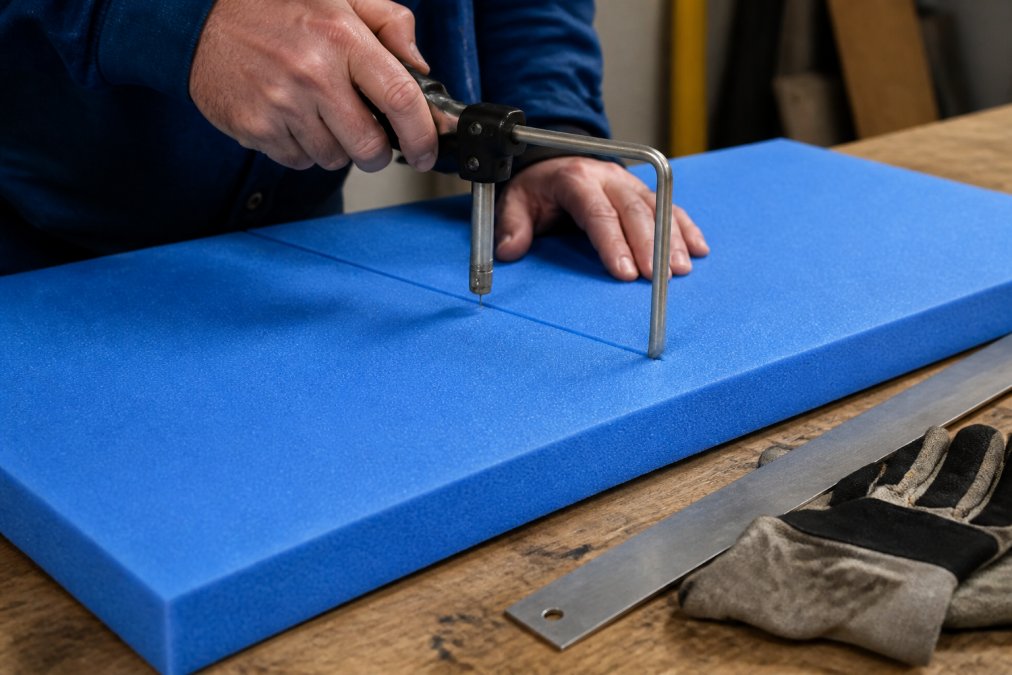
Electric carving knives are a hidden gem for thick foam blocks. They cut fast and leave a reasonably smooth surface, though they create more debris than a hot wire. For detailed sculpting, rotary tools with sanding drums shape the foam after the initial cut, and a foam sanding block smooths any remaining rough spots. quality crafting materials.
A common mistake is using a dull blade. A dull knife crushes the foam instead of cutting it, leaving a compressed edge that ruins the piece's dimensional stability. Replace blades frequently, and for curves, use a blade with a shorter, sharper point for better control.
How to Shape Foam for Cosplay Armor: Heat Forming and Sealing
Heat forming is the technique that transforms flat foam sheets into curved armor pieces. Applying controlled heat softens the closed-cell structure, allowing you to bend the foam around a form or mold. When it cools, the foam holds its new shape, creating a durable, three-dimensional piece.

The process requires patience and the right temperature. A heat gun on a medium setting works best; hold it several inches away and keep it moving to avoid scorching the surface. The foam becomes pliable quickly, so work in small sections. Shape the heated area against a curved surface, like a PVC pipe or a custom mold, and hold it until it cools.
After shaping, sealing is essential for durability and a professional finish. Unsealed foam is porous and will absorb paint unevenly. Apply a flexible sealer, such as a water-based acrylic or a dedicated foam coating, to create a smooth barrier. This prevents paint from cracking when the foam flexes and protects the surface from scuffs during wear.
Thickness, Durability, and Cost: Matching the Foam to the Job
Thickness and density work together to determine load-bearing capacity. A half-inch sheet of high-density foam can outperform a two-inch sheet of low-density material under sustained weight. For most projects, match the thickness to the structural requirement, not the perceived need for bulk.
For cosplay armor, quarter-inch to half-inch EVA foam is the standard range for most pieces. Thicker foam adds weight and restricts movement, while thinner foam may not hold a sharp crease or provide enough impact protection. For case inserts and protective padding, half-inch polyethylene offers a strong balance of cushioning and dimensional stability, and it cuts cleanly for custom-fit compartments.
Cost scales with density and thickness, but buying in bulk changes the economics. A single sheet of craft foam from a hobby store costs more per square foot than a full roll purchased from a supplier. FoamNoodles offers polyethylene foam rolls in large formats, like the Polyethylene Flat Foam Roll, which provides fifty feet of material for serious projects. For smaller jobs, the Oodles of Noodles 5/8” x 20 ft Foam Noodles gives you a twenty-foot length of solid-core polyethylene at a fraction of the per-foot cost of craft store alternatives.

The trade-off is storage and commitment. A fifty-foot roll requires space and represents a larger upfront investment. If you are working on a single costume or one small project, a smaller quantity makes more sense. If you build props regularly or outfit a workshop, the bulk option pays for itself quickly.
Visual Identification and Maintenance Guide
You can identify foam type and density without a spec sheet. Closed-cell foams like polyethylene and EVA have a smooth, almost waxy surface that resists water absorption (sciencedirect.com). Squeeze the foam: closed-cell foam bounces back immediately, while open-cell polyurethane allows air to escape and recovers slowly. The weight is also telling; a high-density foam feels noticeably heavier for its size than a low-density equivalent.
Cutting a small edge reveals the cell structure. Closed-cell foam shows a uniform, tight surface with no visible pores. Open-cell foam looks sponge-like with visible voids. This difference drives everything from water resistance to how well the foam accepts paint and adhesive.
Maintenance is straightforward but specific to the material. Clean closed-cell foams with mild soap and water; they resist moisture and dry quickly. Avoid harsh solvents, which can break down the cell structure over time. Store foam flat or rolled loosely, as creasing can create permanent compression lines that affect the material's recovery rate and appearance.
For painted or sealed pieces, touch up scratches promptly to prevent moisture from seeping into the cut edges. Properly maintained, a high-quality closed-cell foam piece can last for years without losing its shape or cushioning properties, making the initial investment in the right density rating worthwhile.
Conclusion: Your High Density Craft Foam Checklist
Choosing the right material comes down to matching the specifications to the stress your project will endure. Before you buy, confirm the density rating, check the firmness or ILD if the application requires support, and verify the cell structure matches your cutting and finishing plans. These three data points prevent the disappointment of a prop that collapses or a cushion that flattens.
The checklist for your next purchase is simple. Identify the material type based on your project: EVA for heat-formed armor, polyethylene for clean-cut panels and padding. Select a density rating appropriate for the wear and tear. Choose a thickness that provides structure without unnecessary weight. Then buy the quantity that fits your actual usage, and consider bulk rolls if you build regularly.
FoamNoodles offers a wide range of high-quality foam solutions, including fire-retardant roll bar padding and polyethylene master rolls, with bulk purchasing options and fast, free shipping. Browse the selection and find the high density craft foam that matches your next build.
Frequently Asked Questions
Which is better, 32 density foam or 40 density foam?
The number refers to the foam's weight in kilograms per cubic meter, a common metric standard. A 40 density foam is heavier and denser than 32 density. For craft projects like cosplay armor, 40 density provides a firmer, more durable base that holds edges better. For general upholstery or cushioning, 32 density is often sufficient and more flexible. For most DIY crafting, choose the higher 40 density rating when you need structural integrity and the lower 32 for softer applications.
What is the difference between foam density and foam firmness?
Density measures the weight of foam per cubic foot (lb/ft³), indicating how much material is packed in. Firmness, measured by Indentation Load Deflection (ILD), tells you how soft or hard the surface feels. A foam can be high density but still soft, or low density but firm. For craft foam, density indicates durability and cell structure, while firmness (ILD) affects how it holds a shape. You need both specs to predict how the material will perform.
Is higher density always better for craft projects?
Not always. Higher density foam is more durable, holds crisp edges, and resists wear, making it ideal for armor and props. However, it is heavier, harder to cut, and more expensive. For projects that need flexibility, like curved bases or soft padding, a lower density is easier to work with. Match the density to the project's needs. Use high density for structural pieces and reserve medium density for parts that require bending or comfort.
What does the 'lb/ft³' rating mean on foam products?
The lb/ft³ rating is the density measurement, indicating how many pounds a cubic foot of the foam weighs. A 1.8 lb/ft³ foam weighs 1.8 pounds per cubic foot. This number is a direct indicator of the material's quality and longevity. Higher numbers mean more polyurethane or polyethylene material is packed into the same space, resulting in a firmer, more supportive, and longer-lasting product that resists sagging and compression.
How do I determine the right density for cosplay armor vs. upholstery?
Cosplay armor requires a higher density foam, typically 2.0 lb/ft³ or more, to maintain its shape, hold heat-formed curves, and withstand impact. Look for EVA or cross-linked polyethylene foam. Upholstery, on the other hand, prioritizes comfort, so a medium density (1.5-1.8 lb/ft³) with a lower ILD rating is usually a better choice. For crafting, always prioritize density and firmness for structure, whereas for seating, focus on support and comfort.
How does high-density foam hold up to heat and shaping tools?
High-density polyethylene (PE) and EVA foams respond well to heat, making them ideal for shaping. Using a heat gun, you can heat the foam to around 250°F to make it pliable, then bend it over a form to create curves for armor. When cooled, it holds its new shape permanently. However, avoid overheating, as it can melt the cell structure and create a glossy, hard surface. Always test on a scrap piece first to gauge the reaction time.