

Table of Contents
- What Pool Noodles Are Made Of (and Why It Matters)
- Why Pool Noodles Break Down: The Four Main Causes
- Signs Your Pool Noodle Needs to Be Replaced
- Pool Noodle Maintenance Tips That Extend Foam Life
- How to Store Pool Noodles So They Last More Than One Season
- Do Jumbo Pool Noodles Break Down Differently?
- Disposing of Broken Pool Noodles Without Adding to Waterway Pollution
- Frequently Asked Questions
Last Updated: September 24, 2026
What Pool Noodles Are Made Of (and Why It Matters)
Pool noodles break down because the foam they're made from is under constant attack from sunlight, chlorine, physical stress, and poor storage. At FoamNoodles, we sell EPE foam noodles every day, and the questions we get most often are about why a noodle that looked fine in June turns brittle and crumbly by August.
The answer starts with the material.
Expanded polyethylene (EPE) foam is a lightweight, closed-cell foam made from polyethylene resin. The "closed-cell structure" means each tiny gas pocket is sealed off from its neighbors, which is what keeps water out and buoyancy in. That structure is also the noodle's weak point over time. Once the cell walls crack, water gets in, the foam loses buoyancy, and the breakdown accelerates.
Here's why the material matters: every cause of breakdown below attacks the same thing, the structural integrity of those closed cells. Understand that, and the maintenance advice later makes a lot more sense.
Why Pool Noodles Break Down: The Four Main Causes
Four forces do almost all the damage: ultraviolet degradation, chemical exposure, physical wear, and storage conditions. Most noodles that fail early are losing the fight against two or more of these at once.
Ultraviolet Degradation and Sunlight Exposure
Sunlight is the single biggest killer of pool noodles. Ultraviolet radiation breaks the polymer chains in polyethylene foam, a process called oxidization. As those chains shorten, the foam loses flexibility and turns brittle.
You'll notice it first as fading color. Then the surface feels rougher. Then it starts shedding.
A noodle left on a pool deck all summer will show UV damage within weeks. A noodle kept in the shade between uses can last several seasons. That difference is almost entirely about sunlight exposure.
Chlorine and Other Pool Chemicals
Chlorine attacks foam from the outside in. Every time a noodle sits in treated water, chlorine and other pool chemicals work on the surface of the foam, gradually weakening the cell walls.
Saltwater pools aren't automatically safer, either. Salt, sun, and repeated wet-dry cycles combine to speed up material fatigue. The foam doesn't dissolve, but it does lose resilience, and a noodle that no longer springs back is on its way out.
Physical Wear, Shredding, and Material Fatigue
Pool noodles take a beating. They get squeezed, sat on, bent, dragged across concrete, and used as swords by every kid at the party.
Each of those actions stresses the foam.
How Storage Conditions Speed Up Breakdown
How you store a noodle between swims matters as much as how you use it. Heat accelerates every chemical process above, including oxidization. A noodle left in a hot garage or shed through summer is baking in a way a shaded one never does.
Signs Your Pool Noodle Needs to Be Replaced
The clearest sign is surface crumbling: if the noodle sheds small foam crumbs when you handle it, the cell structure has already failed and it won't recover. Other signals include a faded, chalky surface, cracks along the length, and a noodle that stays compressed after you squeeze it.
Reject Box of Standard Noodles →
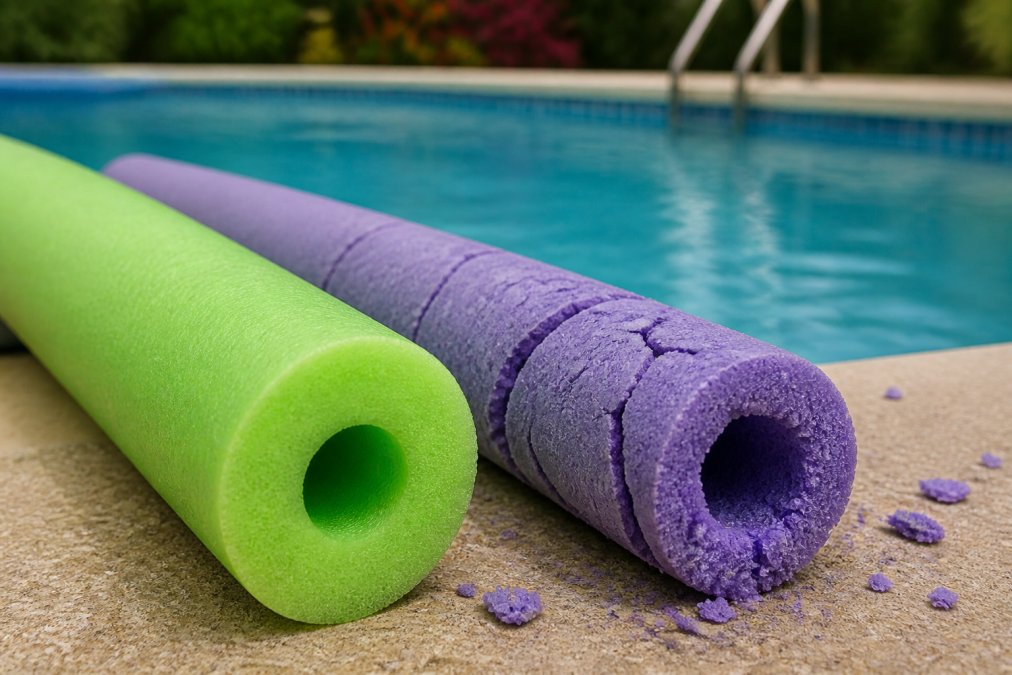
Run through this quick check before each season:
- Does the surface feel chalky or rough instead of smooth?
- Does handling it leave foam crumbs on your hands?
- Are there visible cracks, tears, or deep gouges?
- Does it stay flattened after you squeeze and release it?
- Does it sit noticeably lower in the water than it used to?
- Has the color faded dramatically from its original shade?
Pool Noodle Maintenance Tips That Extend Foam Life
Rinsing your noodles with fresh water after every pool session is the highest-value habit you can build. It removes chlorine and salt before they can work into the surface, and it takes about thirty seconds.
Beyond rinsing:
- Dry noodles fully before storing them. Damp storage is where surface breakdown begins.
- Keep them out of direct sun when not in use, even poolside.
- Avoid dragging noodles across rough concrete or pavement.
- Rotate which side faces up if a noodle sits out for long periods.
- Skip harsh cleaners. A plain water rinse handles almost everything.
How to Store Pool Noodles So They Last More Than One Season
Store pool noodles clean, dry, out of sunlight, and off the ground. That combination addresses UV exposure, moisture, and physical stress at the same time.
A few storage setups that work well:
- Horizontal wall racks in a shaded garage or shed. Noodles stay straight and off the floor.
- A closed storage bin in a cool spot. Keeps dust, sun, and pests away.
- Vertical storage in a closet if you have the height. Support them so they don't lean and bow.
Do Jumbo Pool Noodles Break Down Differently?
Jumbo pool noodles break down the same way as standard ones, but the timeline differs. A larger diameter means a greater ratio of interior foam to exposed surface.
Disposing of Broken Pool Noodles Without Adding to Waterway Pollution
A broken pool noodle is a contained problem until it starts to crumble. Once the foam is shedding crumbs, every handling step, pulling it from the pool, carrying it to the curb, tossing it in a bin, is an opportunity for foam particles to escape into the environment. Those particles don't biodegrade on any useful timescale. They break down further into microplastics, which persist in soil and waterways and are increasingly found in fish and sediment samples.
If the foam is still intact
An intact noodle, one that's faded, dented, or stiff but not shedding, can often be repurposed rather than discarded. Common second lives include:
- Pipe insulation for exposed outdoor plumbing, cut to length and slit along one side.
- Edge bumpers on furniture, workbenches, or garage shelving.
- Dock and boat padding, where a scuffed noodle still absorbs impact.
- Craft and classroom material for projects that don't require a pristine surface.
- Kickboard or float augmentation for supervised swim practice, if buoyancy is still adequate.
If the foam is crumbling
Once a noodle sheds crumbs when you handle it, repurposing is off the table, the material is too far gone to pad anything reliably, and every touch releases particles. At this stage, containment is the priority:
- Bag it before it moves. Slide the crumbling noodle into a heavy-duty trash bag at the point of removal, not after carrying it across the yard. Seal the bag immediately.
- Double-bag if the shedding is heavy. A second bag catches anything that escapes the first during handling and transport.
- Never put loose noodles in an open bin or on the curb. Wind, collection trucks, and rain all move loose foam into storm drains, which typically discharge untreated into local waterways.
- Check local recycling guidance first. Some municipal programs accept polyethylene foam; many do not, and contaminated or crumbling foam is usually rejected. Check your local waste authority's rules before assuming a curbside bin will take it.
- Landfill as the fallback. If recycling isn't available, a sealed bag in the general waste stream is the responsible choice. A contained noodle in a landfill is a stable problem; a loose one in a storm drain is not.
What not to do
- Don't burn old foam. Polyethylene foam releases harmful compounds when burned and is illegal to burn in many jurisdictions.
- Don't leave broken noodles poolside or in the yard, where sun and wind will break them down further.
- Don't rinse crumbs into a driveway or gutter, anything that reaches a storm drain bypasses treatment.
- Don't assume "recyclable" means "accepted locally." The gap between the two is where most foam ends up in the wrong stream.
Frequently Asked Questions
Do pool noodles break down over time even if I barely use them?
Yes. EPE foam degrades from the day it leaves the factory, and sunlight exposure is the biggest driver. A noodle left on a sunny pool deck can show fading and surface brittleness within one season, while the same noodle stored indoors in a dark, dry spot often stays flexible for several years. Chlorine, heat, and physical stress speed the process up, but time and UV alone are enough to weaken the foam.
How does UV exposure affect EPE foam pool noodles?
Ultraviolet light attacks the polymer chains in the foam, a process called ultraviolet degradation. The surface oxidizes, turns chalky or faded, and loses flexibility. Once that outer skin cracks, water gets into the foam cells, and the damage moves inward. Keeping noodles out of direct sun when they are not in use is the single most effective way to slow this down.
Can pool chemicals cause pool noodles to disintegrate?
Chlorine and other sanitizers accelerate chemical exposure damage on EPE foam. They strip the outer surface, leave it brittle, and make shredding more likely, especially on noodles that stay in the water for hours at a time. Rinsing noodles with fresh water after each use and letting them dry fully before storage removes most of the residue that causes this.
Are pool noodles recyclable, or do they end up in landfills?
Most curbside programs do not accept EPE foam, so broken noodles usually end up in landfills. Before that point, you can cut them into sections for pipe insulation, expansion joints, backer rods, or craft projects. Check whether a local facility accepts polyethylene foam, and avoid leaving fragments near storm drains, since foam crumbs contribute to waterway pollution and microplastics.