

Table of Contents
- Why Toddlers Are at Risk Around Sharp Furniture Corners
- How Foam Corner Guards Cushion Impacts and Reduce Injury
- How to Childproof a Table with Foam Protectors
- Corner Guards Falling Off: Why Adhesive Fails and How to Fix It
- Baby Edge Protectors: Comparing Clamp-On, U-Channel, and Wrap Styles
- Corner Protectors Without Adhesive: Clamp-On and Wrap Options
- Is the Investment Worth It? Weighing Protection, Durability, and Cost
- Frequently Asked Questions
Last Updated: October 10, 2026
Why Toddlers Are at Risk Around Sharp Furniture Corners
Toddlers explore the world by touching, climbing, and sometimes falling. A sharp table corner at head height becomes a genuine hazard when a curious child loses balance or takes a tumble. The risk isn't theoretical. Falls from furniture and collisions with sharp edges send thousands of young children to emergency rooms annually.
Foam corner guards address this specific danger by cushioning the impact. When a toddler bumps their head on a padded corner instead of hard wood or metal, the foam absorbs energy that would otherwise transfer directly to their skull. This is why parents and caregivers look to foam corner guards as a practical safety solution.
But the real question isn't whether padding helps in theory. It's whether foam corner guards actually stay in place, hold up to daily wear, and justify the time and money you'll spend installing and replacing them. At FoamNoodles, we work with families and facilities managing these exact tradeoffs. Below, we'll walk through what works, what fails, and whether are foam corner guards worth it for toddlers in your specific situation.
How Foam Corner Guards Cushion Impacts and Reduce Injury
Foam corner guards work by converting a hard collision into a softer one. When a child strikes a corner protected by foam, the material compresses instead of stopping the impact instantly. That compression spreads the force across a larger area and over a slightly longer time. Both factors reduce the peak force hitting the child's head.
The cushioning effect is real, but understanding its limits is critical to deciding whether guards are worth installing. Foam protects against the collisions that happen most often: a toddler losing balance while cruising furniture, bumping their head while playing on the floor near a table leg, or catching a temple on a corner during a minor trip.
However, foam is not a substitute for supervision or a guarantee against serious injury. A child falling from standing height onto a hard corner may still sustain a significant head injury even with padding present. The foam reduces impact force, but it does not eliminate it entirely. This is why foam guards are one layer of protection, not the only one.
The material's non-abrasive surface also prevents scrapes and cuts. A child's skin sliding across soft foam is safer than contact with sharp edges or splintered wood. This secondary benefit often matters as much as the impact cushioning itself, especially for toddlers who are still learning to control their movements and frequently make contact with furniture edges.
One practical consideration: foam guards work best on corners at head height when a toddler is crawling or cruising. A corner at shin height poses a different risk profile and may not justify the same level of protection. Similarly, a sharp corner on a fireplace hearth, where a child might fall from standing height, presents a more serious hazard than a table corner where most contact happens during play at floor level.
How to Childproof a Table with Foam Protectors
Installing foam corner guards on a table starts with surface preparation. Clean the corners thoroughly with soap and water, then dry completely. Any dust, grease, or residue will weaken adhesive bonding.
Measure your table corners to determine which style fits best. U-channel guards wrap around the edge, while clamp-on styles split lengthwise and grip the corner. Adhesive-backed guards stick directly to the surface. Each approach has different installation steps.
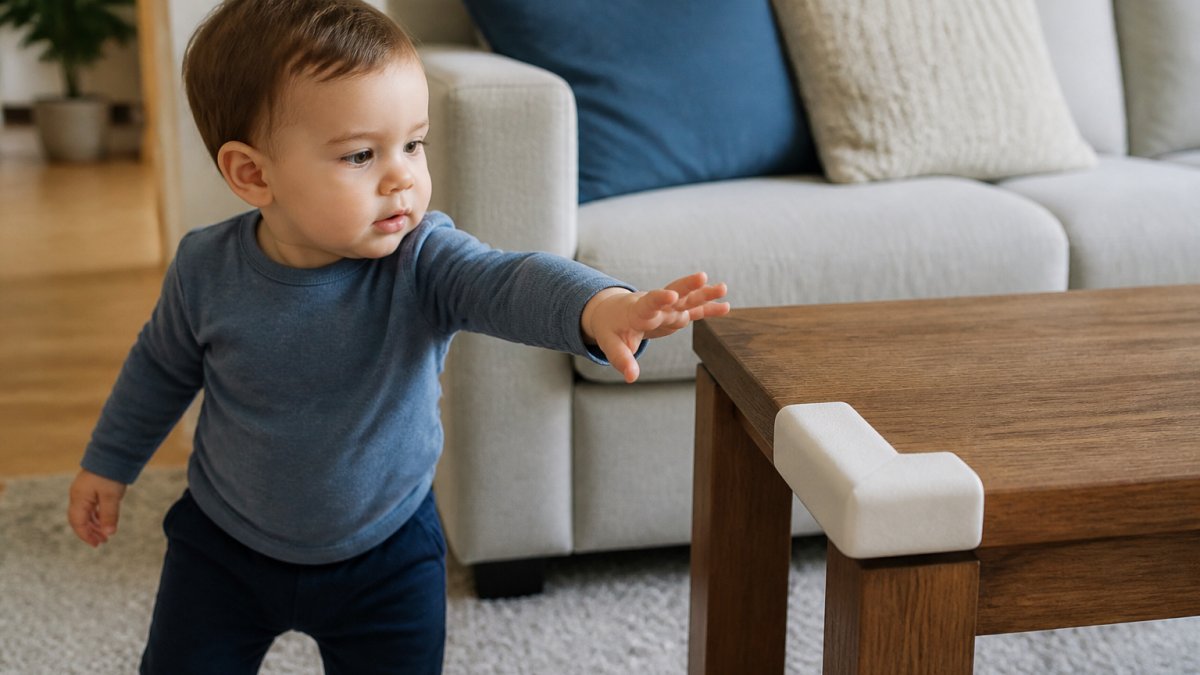
For adhesive guards, position them carefully before pressing down. Most adhesive takes 24 hours to set fully, so avoid moving the table during this period. Press firmly for at least 30 seconds to ensure good contact.
Clamp-on foam noodles like the Standard Clamp-On Foam - 4 Pack ($28.99) work without adhesive. Simply open the slit and slide the foam over the corner. These are easier to reposition if needed and leave no residue when removed.
U-channel protectors from the Oodles of Noodles U-Channel Foam Edge Protectors ($29.99) fit over edges up to 1.5 inches thick. They grip securely without adhesive, making them ideal for furniture with delicate finishes that adhesive might damage.

Corner Guards Falling Off: Why Adhesive Fails and How to Fix It
Adhesive-backed foam corner guards fail for predictable reasons. Moisture is the primary culprit. Humidity, spills, and condensation weaken the bond over weeks or months. Adhesive designed for dry indoor use doesn't hold up in kitchens or bathrooms where moisture is constant.
Temperature changes also cause adhesive to fail. Foam expands and contracts slightly with heat and cold. If the adhesive can't flex along with the material, the bond breaks at the edges first. Once the edge lifts, the rest follows quickly.
The adhesive itself matters tremendously. Budget-grade foam guards often use weak adhesive that fails within weeks. Higher-quality adhesive lasts longer but still eventually gives way to moisture and temperature stress. Persistent issues with surface adhesion often lead parents to reconsider the overall design of a sensory friendly nursery where soft furnishings might provide a more reliable alternative to temporary plastic attachments.
Removing failed guards without damaging furniture requires patience. Heat the adhesive gently with a hair dryer to soften the bond, then peel slowly at a shallow angle. Residue left behind can be rubbed off with your thumb or removed with rubbing alcohol on a cloth. Never use sharp tools that might scratch the finish.
Prevention is more practical than repeated replacement. Choose clamp-on or wrap styles that don't rely on adhesive for high-moisture areas. Save adhesive-backed guards for low-traffic corners in dry rooms.
Baby Edge Protectors: Comparing Clamp-On, U-Channel, and Wrap Styles
Different foam protector styles serve different needs. Understanding the tradeoffs helps you choose the right one for each location.
| Style | How It Works | Best For | Durability | Ease of Removal |
|---|---|---|---|---|
| Clamp-On | Splits lengthwise, grips corner | Any corner shape | Very good | Immediate |
| U-Channel | Slides over edge, grips from inside | Straight edges up to 1.5" | Good | Immediate |
| Wrap (SnakeWrap) | Spirals around object, self-grips | Poles, pipes, irregular shapes | Very good | Immediate |
| Adhesive-Backed | Sticks to surface | Smooth, clean surfaces | Moderate | 1-2 hours with heat |
Clamp-on foam noodles are the most versatile. The Clamp-On 22" Foam Protection - 6 Pack ($23.99) works on smaller furniture, while the Standard Clamp-On Foam - 12 Pack ($52.99) handles larger tables and shelving. They require no adhesive and reposition easily if you rearrange furniture.
Oodles of Noodles U-Channel Foam Edge Protectors, Flexible Foam Guards →


U-channel guards fit snugly over straight edges. The Oodles of Noodles U-Channel Foam Edge Protectors ($29.99) grip securely without tools or adhesive. They're ideal for protecting wood furniture with finishes that adhesive might damage.
Wrap-style protectors like SnakeWrap Foam Protection Multi-Purpose Cushioning - 4 Pack ($21.99) spiral around any shape. They work on irregular surfaces, poles, and curved edges where other styles won't fit. The self-gripping design holds without adhesive or clamps.
Corner Protectors Without Adhesive: Clamp-On and Wrap Options
Non-adhesive corner protectors eliminate the most common failure point. They stay in place through mechanical grip rather than chemical bonding, making them more reliable long-term.
Clamp-on designs split lengthwise along the entire length. You open the slit and slide the foam over the corner. The foam naturally springs back to grip the edge. This works on corners of various sizes because the foam compresses to fit. Once in place, it doesn't move unless you deliberately pull it off.
Wrap styles function similarly but spiral around the object. They're sliced lengthwise and wrapped like a spring. The more you wrap, the tighter the grip. This design accommodates irregular shapes and varying thicknesses that clamp-on styles can't handle.
Both styles are removable without tools and leave no residue. If you need to move furniture, repaint, or clean thoroughly, you simply pull off the foam. There's no adhesive to soften, no residue to scrape away. This makes non-adhesive guards practical for rental properties or temporary installations.
The tradeoff is appearance. Clamp-on and wrap styles are visible as protective equipment. They don't blend into the furniture the way thin adhesive guards might. If aesthetics matter in your space, this is a real consideration.
Is the Investment Worth It? Weighing Protection, Durability, and Cost
Whether foam corner guards justify the investment depends on your specific situation, and the decision is more nuanced than cost alone. A single clamp-on guard costs roughly $3-5 per corner when bought in bulk.
Protection versus product hazards: Foam guards introduce their own safety considerations that must be weighed against the corners they protect. Adhesive-backed guards can peel at the edges, creating a choking hazard if a toddler pulls off pieces.
Age and mobility matter: A child just beginning to walk or cruise furniture benefits significantly from corner protection because balance is still developing and falls are frequent.
Room-specific decisions: High-traffic areas where your toddler plays most often deserve priority. A living room table where your child plays daily warrants protection more urgently than a guest bedroom corner they rarely encounter. Kitchens and bathrooms present moisture challenges that weaken adhesive, making clamp-on or wrap styles the better choice.
Durability and total cost of ownership: Adhesive-backed guards that fail and fall off within weeks provide no protection and waste money. Clamp-on and wrap styles that last 12+ months offer genuine value. If you replace adhesive guards every 3-4 months due to moisture or temperature failure, the cumulative cost exceeds buying non-adhesive styles upfront.
Comparing to alternatives: Foam guards are not the only way to reduce corner hazards. Furniture rearrangement, moving a sharp-cornered table to a less-trafficked area or replacing it with rounded furniture, eliminates the hazard entirely but may not be practical.
The verdict: For most households with toddlers under 3, foam corner guards are worth the modest investment. The protection is real for everyday collisions, the cost is low, and non-adhesive styles eliminate the durability frustration that makes adhesive guards impractical. Start with high-traffic areas and corners at head height, then expand as needed.
Frequently Asked Questions
Are foam corner guards safe for toddlers?
Yes, foam corner guards are safe for toddlers when they meet safety standards. Products like our Clamp-On Foam Protection and Standard Clamp-On Foam are certified ASTM F963-17, meaning they're tested for child safety and contain no harmful chemicals. They cushion sharp edges without creating new hazards. The key is choosing guards that fit securely so they don't detach and become choking risks.
How do you keep foam corner guards from falling off?
Clamp-on and wrap-style guards stay in place without adhesive by gripping the edge mechanically. Our Standard Clamp-On Foam and SnakeWrap use self-constricting or U-channel designs that hold firmly without tape or glue. If you use adhesive guards, clean the furniture surface thoroughly with rubbing alcohol first, apply even pressure for 24 hours, and avoid placing them on waxed or delicate finishes like French polish, which cause adhesive failure.
What's the difference between clamp-on guards and adhesive corner protectors?
Clamp-on guards like our Standard Clamp-On Foam (48 inches, approximately 2.5-inch diameter) grip edges mechanically without tape or glue, making them reusable and furniture-friendly. Adhesive guards bond directly to surfaces but can fail on polished wood or high-traffic areas. Clamp-on options are better for families who rent, move frequently, or want to protect antique furniture without risk of residue or surface damage.
How long do foam corner guards last before they need replacing?
Durability depends on material quality and placement. Foam guards in low-traffic areas (guest bedrooms, shelves) last 2-3 years or longer. High-contact zones (dining tables, play areas) see faster wear from impact and friction. Our foam products are made with durable EPE foam designed for repeated use. Clamp-on styles are more durable than adhesive options because they don't degrade from moisture or adhesive breakdown.
Sharp furniture corners pose a genuine risk to toddlers, and foam corner guards genuinely reduce that risk. The key is choosing a style that stays in place without constant replacement. Clamp-on and wrap-style foam protectors from FoamNoodles provide reliable cushioning without adhesive failure. Start with the corners your toddler encounters most often, and you'll see why so many families make this their first safety investment.