

Table of Contents
- Why Bulk Pool Noodles Beat Single-Store Buying
- Bulk Pool Noodles Specs and Pricing at a Glance
- EPE Foam: Buoyancy, Durability, and Surface Protection
- Polyethylene Foam Roll Options for Wrapping and Cushioning
- Construction Backer Rod: The Same Foam Family, Different Job
- Bulk Foam Noodles for Crafts, Kid Projects, and DIY Builds
- Storing Bulk Foam So It Keeps Its Shape
- Frequently Asked Questions
Last Updated: October 1, 2026
Why Bulk Pool Noodles Beat Single-Store Buying
Buying bulk pool noodles is the single fastest way to cut your per-noodle cost and stop making mid-summer trips to the store. At FoamNoodles, we stock hundreds of thousands of noodles because the math is simple: one 12-pack at $48.99 works out to roughly $4.08 per noodle, and that noodle is longer, denser, and more rigid than the thin seasonal versions that show up on big-box shelves in May and vanish by July.
What You Actually Pay Per Noodle
Retail single noodles typically sell for a few dollars each, but they are usually shorter and lighter, which means they flatten fast in the pool and sag when you use them as padding. Bulk buying changes the equation in three ways: Higher density materials and consistent dimensions ensure that bulk buying benefits extend beyond simple unit savings to provide a more durable and reliable experience for long-term aquatic use.
- Lower unit cost. A 12-pack spreads the price across a full season of use.
- Consistent sizing. Every noodle in the pack matches, so DIY builds and pipe protection line up evenly.
- Free shipping. FoamNoodles ships free on every order, so the price you see is the price you pay.
Bulk Pool Noodles Specs and Pricing at a Glance
Every Oodles Of Noodles 12-pack we sell shares the same core specification, which makes mixing colors for a project predictable:
| Spec | Measurement |
|---|---|
| Length | Approx. 48 inches |
| Diameter | Approx. 2.5 inches |
| Hollow core | 1 inch |
| Pack size | 12 noodles |
| Price per pack | $48.99 |
| Shipping | Always free |
| Safety | ASTM F963-17, ages 5+ |
Color Options and Pack Sizes
FoamNoodles carries assorted, green, yellow, and white 12-packs, all at $48.99. The assorted pack includes purple, red, blue, orange, yellow, and green, which is the practical choice for pool games and kid projects. Green blends into garden and plant supports. White works well for weddings, holiday displays, and any build where you plan to paint or cover the foam.

EPE Foam: Buoyancy, Durability, and Surface Protection
EPE foam, or expanded polyethylene, is a closed-cell foam that resists water absorption, which is exactly why it floats instead of waterlogging. FoamNoodles uses only EPE foam, and every noodle is made in North America with no harmful chemicals, free from BPA, phthalates, and PVC.
Polyethylene Foam Roll Options for Wrapping and Cushioning
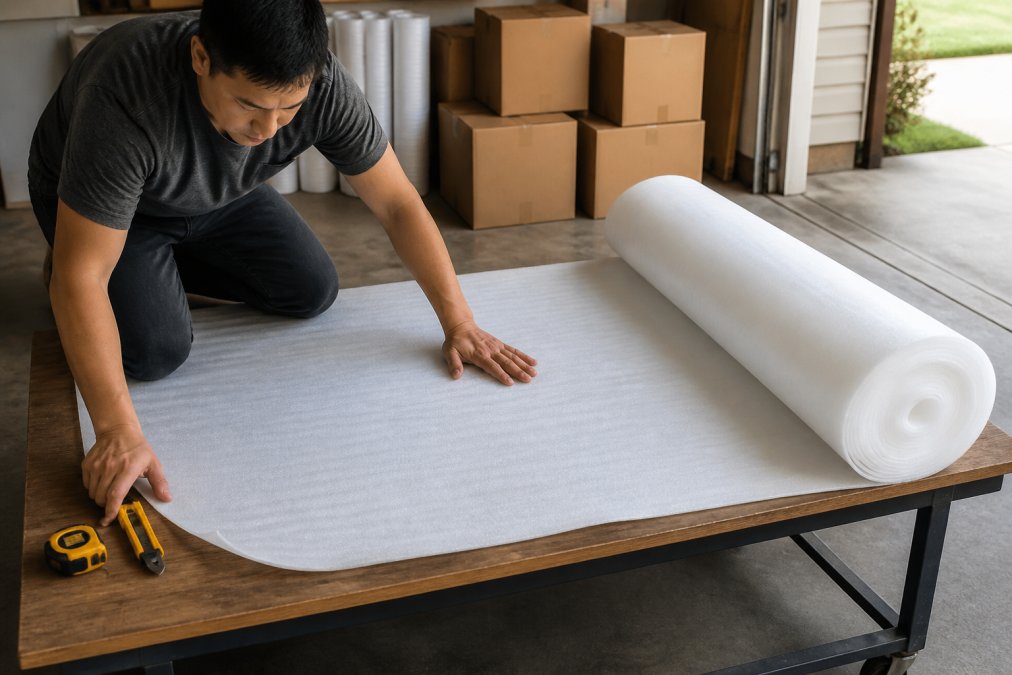
A polyethylene foam roll is the flat-sheet cousin of the pool noodle, and it solves the jobs a round noodle cannot. Where a noodle protects an edge or a pipe, a foam roll wraps flat surfaces, fills voids in a box, and cushions items during shipping. FoamNoodles carries EPE foam rolls in the same closed-cell polyethylene family as the noodles, so the two work together without any material mismatch.
Picking a Roll by What You Are Protecting
Most buyers guess at thickness and end up either overpaying for foam they do not need or under-protecting a fragile item. A simple rule works: match the foam layer to how much shock the item can absorb and how heavy it is.
| Item type | Typical weight | Foam layer to start with | Why |
|---|---|---|---|
| Documents, flat art, thin panels | Under 2 lb | Thin single layer, wrapped twice | Light items need surface protection, not shock absorption |
| Ceramics, glassware, small electronics | 2-10 lb | One wrap plus corner pads | Corners take the first hit in a drop |
| Furniture legs, metal parts, tools | 10-40 lb | Double layer on edges and faces | Heavier items punch through a single layer |
| Appliances, large furniture | 40 lb and up | Multiple layers plus void fill | Mass drives the impact, so thickness scales with weight |
How to Wrap the Three Shapes That Cause Trouble
Flat items. Lay the roll flat, place the item face-down, and fold the foam over the edges like a present. Tape the seams, then flip and repeat so both faces have a full layer. The goal is no exposed corner.
Roll and Noodle Together
Most people buy noodles and rolls together. The noodles handle edges, tubes, and pipes; the roll handles everything flat. A single roll plus a 12-pack of noodles covers a full move or a season of shipping without buying two separate foam types.
Construction Backer Rod: The Same Foam Family, Different Job
Construction backer rod is a flexible, closed-cell foam rope that presses into concrete joints and gaps before sealant goes in, giving the sealant a proper depth and a bond that moves with the joint. It is the same polyethylene family as your pool noodle, just made in smaller diameters for a very different purpose.
Oodles Of Noodles Assorted - 12 Pack →
Contractors keep backer rod on hand for:
- Expansion joints in driveways, sidewalks, and slabs
- Window and door frame gaps before caulking
- Log and masonry joints that need a flexible backing
Bulk Foam Noodles for Crafts, Kid Projects, and DIY Builds
Bulk foam noodles for crafts turn a cheap pool toy into a full craft supply. Because the foam is soft, cuttable, and easy to glue, it works for projects that would cost far more with specialty craft foam.
Popular builds include:
- Pool obstacle courses and floating target games
- Door bumpers to stop slamming and wall scratches
- Plant stakes and garden row markers in green
- Holiday and party decorations in white or assorted colors
- Kayak and canoe padding cut to shape
Storing Bulk Foam So It Keeps Its Shape
Store bulk foam flat, out of direct sun, and away from heavy weight. EPE foam keeps its shape best when nothing is pressing on it and when ultraviolet light is not breaking down the surface. The reason is structural: EPE is a closed-cell foam, so each cell holds its own air pocket. Bend a noodle over a hook for months and those cells compress on the inside of the curve and stretch on the outside.

What Actually Damages Stored Foam
- Sustained bending. A noodle draped over a hook or coiled tight in a bin develops a permanent curve within a season.
- UV exposure. Sunlight breaks down the outer skin of the foam over time, making it chalky and brittle. A garage shelf away from a window solves this.
- Compression under weight. Heavy boxes stacked on loose noodles crush the cells flat, and crushed cells do not recover.
- Heat. A hot attic or the back of a closed car softens the foam and speeds up any set it is already taking.
A Storage Routine That Works
- Keep noodles horizontal on a shelf or in a long bin, not bent over a hook or a nail.
- Store away from windows and hot garage corners.
- Do not stack heavy boxes on top of loose noodles.
- Keep the original packaging for the off-season if you have room, the bag keeps dust off and holds the noodles straight.
- For rolls, store them standing on end or laid flat, never folded, so the sheet does not crease.
Recovering a Noodle That Took a Set
If a noodle does take a set from being bent, lay it flat in a warm room for a day and it will relax back toward straight. That flexibility is a feature of EPE foam, not a flaw. A noodle that has gone chalky or brittle from sun exposure will not recover, the surface has broken down, and that one is best retired to a non-structural job like a garden marker.
Frequently Asked Questions
What are the primary uses for bulk pool noodles beyond swimming?
Bulk pool noodles cover far more than pool games. People cut them into padding inserts for furniture edges and pipe insulation, slice them into craft shapes, and build obstacle courses or garden markers. The 1-inch hollow core makes them easy to thread onto rope, rebar, or pipe. FoamNoodles sells 12-packs in assorted, green, yellow, and white, all about 48 inches long and 2.5 inches wide, so one order can cover several projects at once.
How should bulk pool noodles be stored to maintain their shape?
Keep them flat or standing upright in a cool, dry spot out of direct sun. Heat and long-term compression are what flatten foam, not age alone. Avoid stacking heavy boxes on top of loose noodles, and skip hot garages or attic spaces in summer. If you store them in a bin, lay them horizontally rather than bending them into tight curves. Stored this way, EPE noodles hold their round shape and buoyancy from one season to the next.
What is the difference between standard pool noodles and construction backer rod?
Both are flexible EPE foam, but the job differs. Pool noodles run about 48 inches long and 2.5 inches wide with a 1-inch hollow core, built for buoyancy and play. Construction backer rod is a thinner, round foam rod pressed into concrete joints and gaps before sealant goes in, providing a backstop so caulk fills only the intended depth. Same foam family, different diameter and density needs.
Can bulk pool noodles be used for DIY craft projects?
Yes, and a 12-pack goes further than most people expect. The foam cuts cleanly with a serrated knife or hot wire, holds glue well, and takes paint if you seal it first. Common projects include wreaths, stamped shapes, wreath forms, costume props, and stamp rollers. Because each noodle is about 48 inches long, you get roughly 48 feet of material per pack, enough for a full season of craft projects.
Buying in bulk is the difference between replacing cheap noodles all summer and buying once. FoamNoodles stocks hundreds of thousands of EPE pool noodles, construction backer rod, and craft foam, with free shipping on every order and same-day shipment on most purchases. Whether you need an assorted 12-pack for the pool, a polyethylene foam roll for wrapping, or backer rod for a concrete job, one supplier covers all three. Get started with FoamNoodles and stock the foam you actually use.