

How to Child Proof a Fireplace Hearth at Home
Editorial TeamLast Updated: November 3, 2026
Quick Summary
To child proof fireplace hearths, measure each edge, then pad sharp corners and raised ledges with foam guards or clamp-on foam tubes. Add a gate or screen to keep toddlers away from the fire, and check every piece regularly for looseness or wear.
- Measure each hearth edge, depth, and raised ledge height before buying any protection.
- Start padding with the sharpest front corners and raised edges closest to where your child plays.
- Use clamp-on foam tubes on raised ledges so the padding stays in place on stone.
- Anchor gates into wall studs rather than drywall, and test them by pushing in every direction.
- Check all padding monthly for flattening, loosening, cracks or tears, and replace worn pieces.
Table of Contents
- Why Fireplace Hearths Pose a Risk to Toddlers
- Measure Your Hearth Before You Buy Any Protection
- How to Baby Proof Stone Fireplace Hearth Edges
- Baby Proof Fireplace Foam: Choosing the Right Padding
- Installing a Baby Proof Fireplace Gate Safely
- Choosing the Best Childproof Fireplace Screen
- Checking Stability and Protection Once Everything Is Installed
- Your Next Step: Protecting Your Hearth This Week
- Frequently Asked Questions
Why Fireplace Hearths Pose a Risk to Toddlers
A fireplace hearth is one of the hardest, sharpest spots in a home. Toddlers learn to walk, climb and fall at the same time, and a stone edge at head height can turn a short tumble into a serious bump.
Hearths are often built from stone, tile or brick. These surfaces are hard, and their corners and raised edges do not give at all.
Here is what makes hearths risky:
- Hard, unforgiving stone or tile
- Sharp corners at child head height
- Raised or stepped edges that catch knees and feet
Padding helps, but padding works best alongside a plan. Think of it as one layer of protection.
Measure Your Hearth Before You Buy Any Protection
Before you shop, measure the hearth so the protection fits. Guessing leads to gaps, loose pieces and frustration.
Follow these steps:
- Measure the length of each hearth edge you want to cover.
- Measure the depth of the hearth, from the wall to the front edge.
- Note the height of any raised or stepped edge.
- Measure the width of any corner you plan to pad.
- Write everything down and bring the list to the store or your computer.
Foam corner guards come in set lengths, so you may need to cut them. A common approach is to buy a little extra, then trim for a snug fit. Check the fit by pressing the guard on and tugging gently. It should not slide or pop off.
How to Baby Proof Stone Fireplace Hearth Edges
Stone is cold, hard and unforgiving. Start with the sharpest edges first, usually the front corners and the top of any raised ledge. Work your way along the hearth from there.
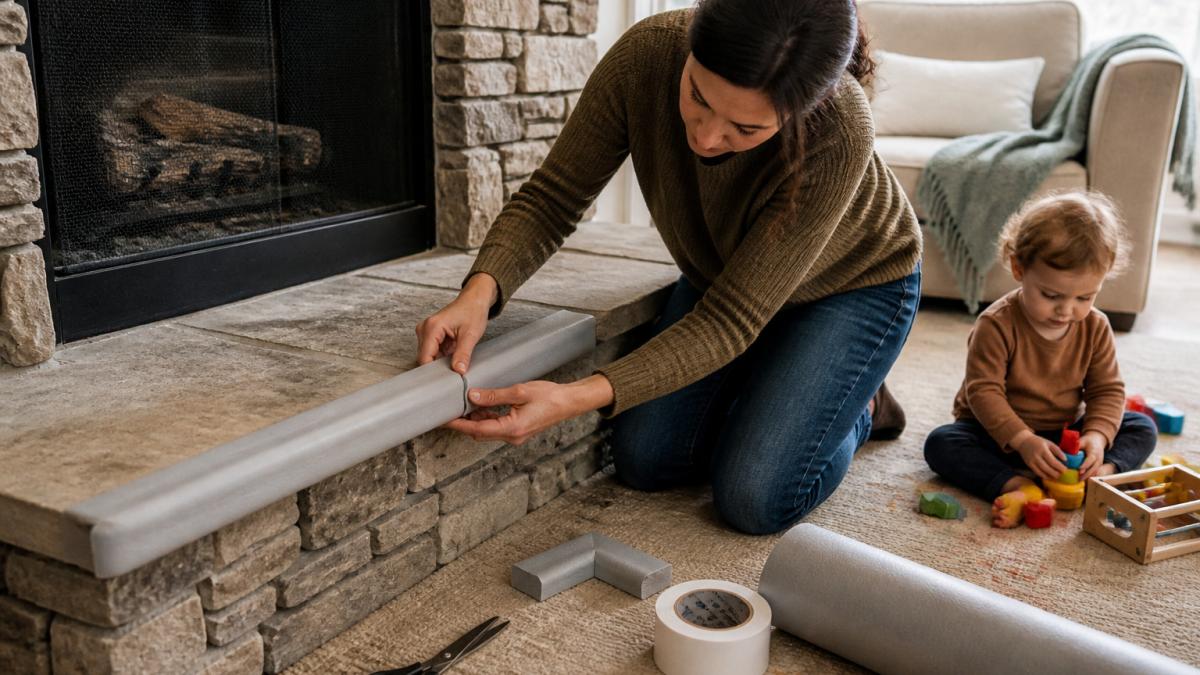
Most families find that a simple routine works well:
- Clean the stone edge so the adhesive or clamp grips well.
- Choose the right protection for the shape of the edge.
- Fit the padding snugly along the corner or ledge.
- Press firmly and check that nothing shifts.
- Walk around the hearth and test each piece by hand.
Padding Hard Corners and Raised Edges
Corners take the most impact, so start there. Read whether foam corner guards are worth it for toddlers to see when they make sense for a hearth.
Raised edges need a different approach. Use a tube-style foam that clamps onto the edge.
A quick check helps. Press the padding with your hand. If it flattens completely or feels loose, it will not protect well.
Using Foam Corner Guards on Stone Surfaces
Stone surfaces need firm grip. The Clamp-On Jumbo Size Foam Noodles - 2 Pack (product) are pre-cut foam clamps, roughly 48 inches long and 3.5 inches in diameter, which can be trimmed with kitchen or sharp scissors to fit a hearth edge.

The Oodles of Noodles Tough Skin Foam Clamp Padding, 48" x 3.25" (product) is made from closed-cell foam with a thick outer skin and has a partially pre-slit design that allows it to be opened as a full tube or wrapped around edges.
Baby Proof Fireplace Foam: Choosing the Right Padding
Not all foam is the same. The right choice depends on the shape of your hearth and how much your child climbs.
Compare your options:
| Hearth Feature | Best Padding Type | Why It Works |
|---|---|---|
| Sharp front corners | Corner guard | Wraps the corner and absorbs impact |
| Raised ledge | Clamp-on foam tube | Grips the edge and covers its full length |
| Long straight edges | Pre-slit foam tube | Easy to open and wrap along the length |
| Thin edges or trim | U-channel edge protector | Slides onto narrow edges and stays in place |
The U-Channel Foam Edge Protectors (product) are flexible foam guards with a 1.5-inch channel opening that fits product thicknesses up to 1.5 inches, and they can be trimmed with a standard knife.

When choosing foam, look for these qualities:
Clamp-On Jumbo Size Foam Noodles - 2 Pack - Extra Dense, Buoyant Foam Tubes →
- Dense, closed-cell construction
- A firm but flexible feel
- Non-abrasive material
- Pre-cut lengths or easy trimming
Installing a Baby Proof Fireplace Gate Safely
A gate or barrier keeps a toddler away from the hearth altogether, and it is usually the strongest single layer you can add. The difference between a gate that works and one that fails is almost always the installation, not the gate itself.
Match the gate to your fireplace type
Clearance and heat behavior differ by fireplace, so pick the barrier with the firebox in mind:
- Wood-burning fireplaces throw radiant heat well past the firebox opening and can spit embers when a log shifts. Use a freestanding barrier that stands back from the opening rather than one that presses against the surround, and keep the barrier's feet outside the hearth's hot zone.
- Gas fireplaces often have hot glass fronts that stay dangerous long after the flames are off. A gate keeps small hands off that glass, but the gate itself must not touch or lean on the front.
- Electric fireplaces run cooler at the surface but still produce heat at the outlet and can tip if a child pulls on a lightweight surround. Anchor the barrier to the wall or floor rather than to the unit.
Most fireplace manufacturers publish a minimum clearance to combustibles in the owner's manual. Read that number before you place any gate, screen, or fabric near the opening, and follow it rather than a rule of thumb.
Anchor the gate so it cannot be pushed over
- Choose a gate sized to the opening with no gap wider than a few inches at the sides or top.
- Decide on the mounting method: pressure-mounted gates rely on friction and suit doorways, while hardware-mounted gates screw into studs and are the safer choice around a hearth a toddler can lean on.
- Locate wall studs with a stud finder and drive the mounting brackets into them, not just into drywall.
- Set the gate so the latch sits above a toddler's reach but below an adult's shoulder.
- Push, pull, and lean your body weight against the gate in every direction before you trust it.
Watch out: a pressure-mounted gate placed against a stone or tile surround can slip when a child hangs on it, because smooth masonry gives the rubber pads little to grip, use hardware mounting on masonry.
Safe operation around a live fire
A barrier is not a substitute for supervision, and it must never be used to block access to a fire that is still hot or still burning. Keep these rules:
- Wait until the firebox, glass, and surround are cool to the touch before you move or adjust any barrier.
- Never drape blankets, fabric, or padded covers over a gate or screen near an active fire.
- Keep the gate's path clear so an adult can reach the fire and any safety controls quickly.
- Store matches, lighters, and fireplace tools well outside the barrier zone.
Inspect the installation over time
Gates take a beating from climbing toddlers. Once a month, tighten every fastener, confirm the latch still engages, and check that the gate has not shifted away from the wall. Replace any bracket that has pulled loose rather than reusing the same holes.
Choosing the Best Childproof Fireplace Screen
A screen is a useful second layer, but most buying advice stops at "pick a sturdy one." A screen has to do two jobs at once: keep a child's hands off hot surfaces and stay put when a toddler leans on it. Use a neutral checklist rather than a product listing.
What a screen can and cannot do
A screen blocks reaching and discourages climbing, but it does not replace supervision, a gate, or hearth padding. Treat it as one layer among several, and never rely on a screen alone to keep a child away from an active fire.
A buying checklist for fit, heat, and stability
Run through these criteria before you buy:
- Height and reach: the screen should be tall enough that a standing toddler cannot reach over the top and far enough forward that a child cannot touch the firebox or glass.
- Stability: a wide, weighted base resists tipping better than a narrow one. Test it by pushing the top edge; it should not rock or slide.
- Attachment: freestanding screens can be shifted by a determined child. If the screen is not anchored, place it so furniture or a gate backs it up.
- Mesh size: small openings keep fingers out; large decorative cutouts defeat the purpose.
Glass fronts and hot surfaces
Many gas fireplaces have glass fronts that reach scalding temperatures and stay hot for a long time after shutdown. A screen in front of that glass adds a barrier, but it does not cool the glass. Keep the screen far enough forward that a child cannot press a hand between the screen and the glass, and treat the glass as hot until you have confirmed it is cool.
Pair the screen with the other layers
A screen stops access; padding softens the bump if a child still falls against the hearth. Use both, and check the screen's position every time you clean the fireplace or move furniture, since a screen that has drifted forward loses much of its value.
Checking Stability and Protection Once Everything Is Installed
Once your padding and barriers are in place, test everything. A quick check now can prevent injuries later.
Run through this list:
- Press each foam piece. It should stay put without sliding.
- Tug each corner guard gently. It should hold firm.
- Push the gate and screen. Neither should wobble or tip.
- Walk the hearth and look for any exposed sharp edges.
Replace any padding that cracks, flattens or peels. Worn foam loses its ability to absorb impact.
Your Next Step: Protecting Your Hearth This Week
Start small today. Measure one hearth edge, pick the corner that sits closest to where your child plays, and cover it first. Then work around the rest of the hearth over the coming days.
Protecting a hearth does not need to be complicated. Clear steps, a good fit and regular checks will keep your home safer. FoamNoodles offers foam products that can be used for hearth edges, corners and raised ledges, so you can start with the products that fit your space.
Frequently Asked Questions
How do you childproof a fireplace hearth?
Start by padding hard hearth edges and corners with foam guards, then add a physical barrier such as a fireplace gate or screen to block access to the hearth. Measure the hearth first so the protection fits snugly. Check that every piece is stable and that nothing can be pulled loose by a child. Re-check the setup regularly, especially as your child grows and becomes more mobile.
Should you use padding or a gate around a fireplace hearth?
Use both when you can. Padding softens the impact of falls against sharp or hard edges, while a gate or screen keeps a crawling or walking child away from the hearth entirely. Padding alone does not stop a child from reaching the fire area, and a gate alone does not cushion an accidental fall. Combining the two gives the most complete protection for toddlers.
Can a fireplace screen keep a toddler safe?
A well-fitted fireplace screen can block a toddler's access to the hearth and fire area, but only if it is sturdy, tall enough, and anchored so it cannot be pushed over. Choose a screen that stays in place when leaned on and check that there are no gaps a child could squeeze through. A screen should work with a hearth pad or corner guards rather than replace them.
What should you check after installing a fireplace barrier?
After installing a barrier, shake it firmly and push on it from several sides to confirm it is stable. Make sure all foam pieces are secured, with no loose ends a child could pull off. Look for gaps, sharp exposed edges, and anything that could tip. Repeat these checks every few weeks, since foam and fasteners can loosen over time with daily use.
