

What Drives Polyethylene Foam Manufacturing Costs
Editorial TeamLast Updated: November 5, 2026
Quick Summary
Polyethylene foam manufacturing costs are driven by five cost pools: resin, conversion energy, labor and equipment, yield loss, and margin. Resin sets the floor price and tracks oil and gas markets, while density, thickness, run length, and customization determine how much each pool adds to your quote.
- Resin is the largest single share of a finished roll's price and sets the floor beneath every quote.
- Continuous extrusion favors long runs of one density; chemical cross-linking tolerates wider density ranges at higher fixed energy and labor.
- Yield loss comes from startup trim, off-spec density, edge trim, and rework or regrind.
- Density is the biggest spec lever: a 4 lb/ft³ sheet costs materially more to produce than a 2 lb/ft³ sheet.
- Compare quotes on landed cost per usable unit, not unit price alone.
Table of Contents
- The Five Cost Pools Behind Every Polyethylene Foam Quote
- How Is Polyethylene Foam Made, and Where Do Costs Enter the Process?
- Resin, Oil Prices, and Feedstock: The Raw Material Cost Story
- PE Foam Density and Thickness: How Specs Change Unit Cost
- Polyethylene Foam Price: What a Real Quote Looks Like Line by Line
- Order Size, Customization, and Total Landed Cost
- Comparing a Polyethylene Foam Roll Before You Commit to a Bulk Order
- Frequently Asked Questions
The Five Cost Pools Behind Every Polyethylene Foam Quote
Every polyethylene foam quote you receive is the sum of five cost pools: resin, conversion energy, labor and equipment, yield loss, and margin. Understanding factors influencing polyethylene foam manufacturing costs starts with accepting that resin alone can account for the largest single share of a finished roll's price.
Below, we break down each pool and show where your money actually goes.
Why Resin Sets the Floor Price
Polyethylene resin is the floor beneath every quote. A converter cannot sell foam for less than the polymer cost embedded in it, no matter how efficient the line runs.
That floor moves with the broader plastics market. U.S. Energy Information Administration data on petroleum and natural gas prices tracks the feedstock costs that ultimately feed resin pricing.
The practical takeaway: a supplier quoting far below everyone else is usually cutting density, using regrind, or shaving thickness.
How Is Polyethylene Foam Made, and Where Do Costs Enter the Process?
Polyethylene foam is made by melting polyethylene resin, blending in additives and a chemical blowing agent, then expanding the mix through extrusion or a chemical cross-linking process into a continuous sheet or plank.
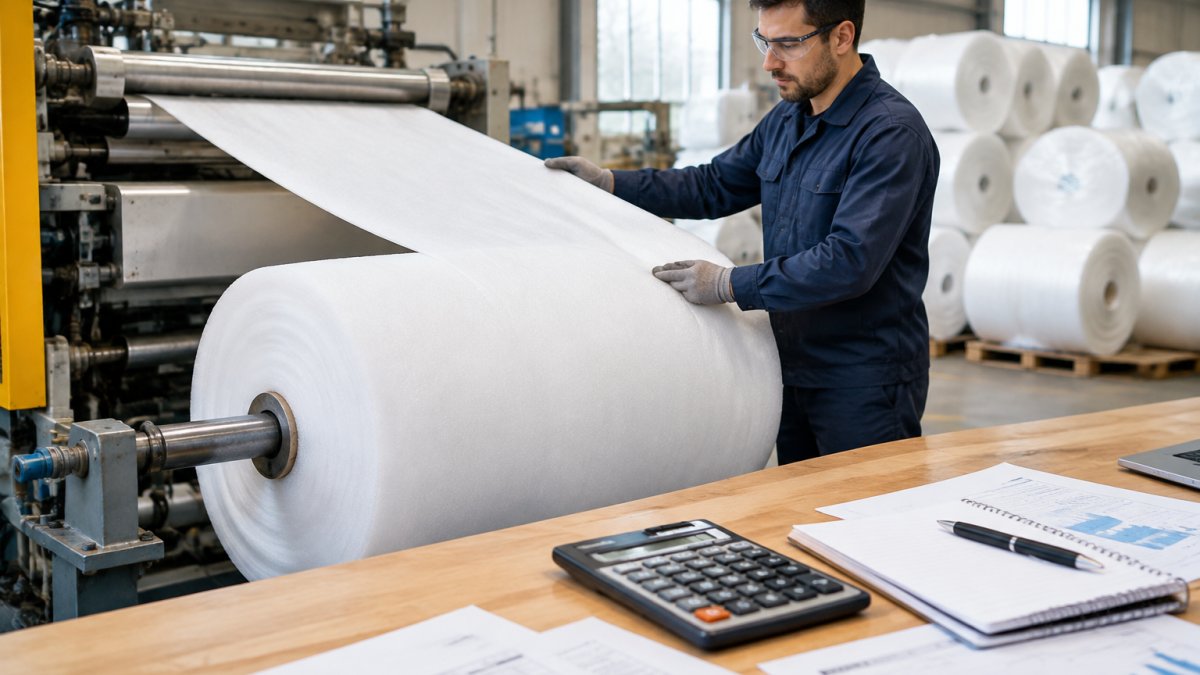
The Two Process Paths and What Each Costs
Most expanded polyethylene on the market is made one of two ways, and the choice shapes unit cost before a single order is quoted:
- Continuous extrusion with a physical blowing agent. Resin is melted, gas is injected under pressure, and the pressure drop at the die causes expansion. This path favors long runs of a single density and thickness because the line stabilizes once and stays there. Energy per pound is relatively steady, but changeovers are expensive.
- Chemical cross-linking and expansion. Resin is compounded with a chemical blowing agent, formed into a sheet, then expanded in an oven. This path tolerates a wider density range and finer cell structure, but it adds compounding, oven energy, and curing time to the cost stack.
A converter running the extrusion path will quote long runs of standard EPE more aggressively than short custom runs, because the startup cost is spread across more feet. A cross-linking line can absorb more spec variety but carries higher fixed energy and labor per pound.
Where Yield Loss Actually Comes From
The extrusion line is where efficiency separates a profitable converter from a struggling one. Foam that expands unevenly, scorches, or collapses gets scrapped, and that scrap has to be paid for by the good product. Yield loss shows up in four places:
- Startup trim while the line stabilizes after a changeover or a cold start
- Off-spec density when temperature or blowing-agent rate drifts outside the target window
- Edge trim cut away to deliver a clean roll width
Startup and changeover losses weigh more heavily on short runs, which is one reason run length can change the unit price a converter quotes.
Line Speed, Energy, and Labor Economics
Energy intensity per pound depends on how hard the line works to melt resin and drive expansion.
Labor follows the same logic. Extrusion lines are lightly staffed during steady running but need attention at startup, changeover, and quality checks.
When comparing a low unit price on a short custom run against a long-run quote, ask how startup trim is handled.
What to Ask a Converter About Process Cost
Before you accept a unit price, ask four process questions:
- Which process path do you run for this density and thickness?
- What is your typical startup and changeover scrap rate?
- Do you blend regrind, and at what ratio?
The answers tell you more about where the price came from than any marketing page, and they let you compare two quotes on the same process basis.
Resin, Oil Prices, and Feedstock: The Raw Material Cost Story
Raw material costs dominate the conversation because they are the most volatile input. Polyethylene is derived from ethylene, which tracks natural gas and crude oil markets.
For a deeper look at how expanded polyethylene economics work at scale, our bulk EPE foam buying guide walks through the feedstock side in more detail.
Two forces push in opposite directions. Oil price fluctuations raise resin costs, while feedstock availability and new production capacity can soften them. Suppliers with long-term resin contracts smooth the ride; spot buyers feel every swing.
PE Foam Density and Thickness: How Specs Change Unit Cost
Density is the single biggest spec lever on unit cost.
Thickness compounds it. Doubling thickness roughly doubles material consumption per square foot. That is why buyers who over-spec "just to be safe" pay for cushioning they never use.
Our polyethylene foam roll guide covers how to match density and thickness to a real application, from packaging cushioning to buoyancy components.
| Spec Change | Effect on Unit Cost | When It's Worth It |
|---|---|---|
| Higher density | Higher resin use per volume | Heavy loads, repeated compression |
| Greater thickness | More material per square foot | Impact absorption, gap filling |
| Tighter tolerance | More scrap, slower line speed | Precision case inserts, fabrication |
| Custom cutting | Added labor and setup | Ready-to-use parts, less waste on site |
Polyethylene Foam Price: What a Real Quote Looks Like Line by Line
A transparent polyethylene foam price breaks into itemized lines, not one lump number. Here is how we would read a quote from any converter:
- Resin cost: polymer grade and weight, priced per pound
- Conversion: energy, blowing agent, additives, line time
- Yield adjustment: scrap allowance baked into the unit price
If a quote arrives as a single figure with no breakdown, you cannot tell whether you are paying for resin or for someone's inefficiency. Push for the itemization. ASTM International standards for flexible cellular materials give you a shared vocabulary for specifying foam so both sides quote the same thing.
Order Size, Customization, and Total Landed Cost
Total landed cost is the number that actually matters: unit price plus freight, handling, and waste, divided by usable product. Order size changes all of it, and most buyers compare unit prices when they should be comparing landed cost per usable square foot.
The Landed Cost Equation
A practical way to compare quotes is to build a landed cost per usable unit:
Landed cost per usable unit = (unit price × ordered quantity + setup and tooling + freight and handling + duties and fees + expected waste) ÷ usable units received
Each term moves differently with order size:
- Unit price falls as quantity rises because resin buying, line time, and overhead spread across more output.
- Setup and tooling is fixed per order, so it dominates small orders and nearly disappears on bulk runs.
- Freight and handling scales with weight and volume, and oversize foam rolls are volume-limited rather than weight-limited, so freight per unit can stay stubbornly high even on large orders.
How Order Size Moves the Number
Small orders carry setup costs spread across fewer units, so the fixed portion of the quote is large relative to the unit price.
A common pattern is that the landed cost per usable unit falls sharply from sample quantities to a first production order, then flattens, then can rise again at very large quantities once storage, handling, and inventory carrying costs are counted.
How Customization Changes the Math
Customization adds cutting labor and setup but can cut on-site waste, which often nets out cheaper for a fabricator. The trade-off depends on three things:
- Cut complexity. Simple slit-to-width rolls add little labor; die-cut or routed parts add setup and per-part time.
- Tolerance. Tighter tolerances slow the line and raise scrap, which shows up in the unit price.
- Format. Rolls, sheets, and planks ship and store differently, so the same foam in a different format can carry a different landed cost.
A buyer who can accept a standard roll width and cut in-house often beats a buyer who orders finished parts, even after counting their own labor, but only when their in-house cut quality is good enough to avoid waste.
Freight, Damage, and the Hidden Cost of Oversize Foam
Freight damage on oversize foam is a real cost. A crushed or bent roll is a total loss, so confirm how a supplier packs and ships before you commit to a large order.
Watch out: a quote that looks cheapest per roll can lose on landed cost once freight damage, re-shipment, and schedule delay are counted, ask for the packaging spec and the damage-claim process in writing.
A Landed Cost Checklist
Before you compare two quotes, confirm both are stated on the same basis:
- Unit price at the same density, thickness, and tolerance
- Setup and tooling charges itemized separately
- Freight terms and packaging spec in writing
Our bulk versus retail foam pricing comparison lays out the full math, including when a bulk roll beats buying standard sizes at a store.
Comparing a Polyethylene Foam Roll Before You Commit to a Bulk Order
Before you sign a bulk purchase order, compare rolls on four things: density consistency, thickness tolerance, cut quality, and how the supplier handles freight. A cheap roll that arrives out of spec costs more than a fair-priced roll that arrives right.
If you want to see a specific product to anchor your comparison, our polyethylene flat foam roll lists the material, dimensions, and closed-cell construction in plain terms. Use it as a benchmark when you evaluate other quotes.

A quick checklist before you commit:
-
Confirm density and thickness with a written spec
-
Ask for the resin grade and whether regrind is used
-
Confirm packaging and freight terms
-
Compare total landed cost, not unit price alone
Frequently Asked Questions
What factors affect polyethylene foam manufacturing costs?
Resin price is the biggest single driver, because polyethylene foam is mostly polymer by weight. Oil prices and feedstock availability move resin pricing up and down. Density and thickness decide how much material each roll consumes. Production efficiency, scrap rate, energy, labor, and order volume fill out the rest. A supplier quoting you a polyethylene foam price is pricing all of these at once, which is why two quotes for the same dimensions can differ by a wide margin.
How do foam density and thickness affect material costs?
Density and thickness multiply together. A denser foam uses more resin per cubic foot, and a thicker sheet uses more volume per square foot, so both raise the material cost of a roll before any processing is added. A 1/2-inch roll at a given density uses roughly half the resin of a 1-inch roll at the same density. When you compare quotes, confirm both numbers, because a cheaper roll is often just thinner.
How do order volume and production runs influence foam pricing?
Long production runs spread setup, changeover, and machine time across more finished feet, so the per-unit cost drops. Short custom runs carry the same setup cost over fewer units. Bulk orders also improve freight economics, since a full truckload costs less per roll than a handful of loose cartons. If your project allows standard dimensions, ordering in larger quantities is usually the simplest way to lower your unit cost.
How do converting, packaging, and shipping affect the total cost of foam rolls?
Converting covers cutting, slitting, and trimming to your dimensions, and custom sizes add labor and scrap. Packaging matters more with foam than with dense goods, because foam is bulky and light, so you pay for space rather than weight. Shipping damage from poor packing creates replacement cost on top of freight. Ask how a supplier packs rolls for transit, and factor landed cost, not just the unit price, into your comparison.
Comparing foam quotes is really comparing how well each supplier controls resin, yield, and freight. FoamNoodles stocks closed-cell polyethylene foam rolls and backer rod in bulk, ships fast and free, and prices every order so you can see what you are buying. Browse our full foam catalog and get a quote that holds up line by line.
