

Table of Contents
- What Makes Professional Foam Different From Retail Foam?
- The Role of Foam Density in Durability
- High Density vs High Resiliency Foam: Which Lasts Longer?
- The 2026 Foam Density Chart: What the Numbers Actually Mean
- Beyond Density: Testing Standards That Predict Longevity
- How to Test Foam Quality Before You Commit
- Signs Your Foam Is Failing and When to Replace It
- Conclusion: Choose Professional Foam for Projects That Need to Last
- Frequently Asked Questions
Last Updated: September 6, 2026
What Makes Professional Foam Different From Retail Foam?
Professional foam is manufactured to stricter tolerances using higher-grade raw materials, so it lasts longer in demanding applications. Retail foam is often produced to meet a price point, not a performance standard.
Professional-grade foam is engineered with a specific polymer and cell structure to resist compression set, permanent deformation from prolonged pressure. Retail foam frequently uses cheaper polyurethane blends with inconsistent cell structures, feeling fine in the store but degrading quickly under regular use, sagging within months rather than years.
This distinction matters most for contractors, product developers, and DIY enthusiasts who need predictable performance. When you buy a backer rod or foam padding, you are betting on structural integrity over time, a bet retail options often lose.

The Role of Foam Density in Durability
Foam density, measured in pounds per cubic foot, is the most cited indicator of durability because it directly correlates with the amount of material present. Higher density means more polymer per volume, which translates to greater load-bearing capacity and resistance to material fatigue. A standard retail foam might sit around 1.5 to 1.8 pounds per cubic foot, while professional grades typically start at 2.0 and climb higher.
Density is necessary but not the whole story. Two foams with identical density can perform very differently based on resilience and compression set values. Density tells you how much material is there; resilience tells you how well it recovers from compression.
The Chemistry Behind the Density Number
Density is a proxy for something more fundamental: the polymer structure. Polyurethane foam is created by reacting polyols with diisocyanates, producing a polymer matrix with gas bubbles trapped inside. Professional-grade foam uses higher molecular weight polyols and more precise isocyanate ratios, creating longer polymer chains that resist breaking under repeated stress.
Retail manufacturers often cut costs with lower-grade polyols or fillers like calcium carbonate that add weight without structural strength. This is why two foams with the same density can perform so differently.
Cell Structure: Open vs. Closed
Cell structure, open or closed, determines how foam interacts with moisture and air. Open-cell foam, typical of polyurethane cushioning, allows air movement that aids recovery but also permits moisture absorption. Closed-cell foam, typical of polyethylene, traps gas in discrete pockets that resist water penetration entirely.
This distinction matters more than density for certain applications. A closed-cell polyethylene foam at 2 pounds per cubic foot will outperform an open-cell polyurethane foam at 3 pounds in any moisture-exposed application.

Density's Effect on Thermal and Chemical Stability
Density affects thermal stability, moisture resistance, and tensile strength. Low-density foam absorbs more moisture and breaks down faster in humid environments, making professional-grade materials critical for outdoor or marine applications.
The polymer chemistry also determines temperature tolerance. Polyurethane foam begins to degrade above 200°F, while polyethylene foam maintains its properties up to 250°F and remains flexible down to -40°F (pubs.acs.org). For construction applications like backer rods that must perform across seasonal temperature swings, this thermal stability range is a critical specification that density alone cannot predict.
Why Density Claims Can Mislead
A common retail pattern is "density inflation", labeling a product high-density when it falls in the medium range, because no federal regulation requires verifying density claims. A reputable supplier tests every batch and provides a certificate of analysis.
The Real Cost Calculation
When comparing prices, calculate cost per pound of actual polymer, not per cubic foot. A "bargain" foam at 1.5 pounds per cubic foot might cost $0.50 less per board foot than a professional-grade foam at 2.5 pounds, but it contains 40 percent less polymer. Spread over usable life, professional-grade often costs less per year of service, the economic argument that drives contractors to specify it despite the higher upfront price.
High Density vs High Resiliency Foam: Which Lasts Longer?
High-resiliency foam often outperforms high-density foam in applications involving repeated compression, even at lower density. Resilience measures how quickly and completely foam returns to its original shape after load removal, making it a stronger predictor of long-term performance for seating, cushioning, and padding.
The trade-off: high-density foam resists sagging under constant weight, ideal for load-bearing applications like mattress cores. High-resiliency foam, often open-cell, excels at recovering from repeated impacts, making it better for upholstery and protective gear.
| Foam Type | Best Application | Primary Strength | Primary Weakness |
|---|---|---|---|
| High-Density | Mattress cores, structural padding | Resists permanent sagging | Can feel firm, slower recovery |
| High-Resiliency | Upholstery, protective cushions | Recovers quickly from compression | Lower load-bearing capacity |
| Closed-Cell Polyethylene | Construction backer rods, flotation | Moisture resistant, chemically inert | Limited cushioning comfort |
For construction and industrial use, closed-cell polyethylene foam is the professional standard. Its structure prevents water absorption and resists chemical degradation, which is why products like the FILL-RITE Pre-Caulking Filler Rope Backer Rod from FoamNoodles are specified for joints that need to last decades. Sealants will not adhere to it, so no bond breaker is required, and it remains flexible across a wide temperature range.
The 2026 Foam Density Chart: What the Numbers Actually Mean
A 2026 foam density chart is only useful if you understand what each range represents. Industry standards classify foam into three tiers: low-density under 1.5 pounds per cubic foot, medium-density between 1.5 and 2.0, and high-density above 2.0. Professional-grade materials for demanding applications usually start at 2.0 and go up. identifying high quality furniture.
These numbers translate to lifespan expectations. Low-density foam in a seat cushion might show visible sagging within a year of daily use; medium-density extends that to several years; high-density, particularly with high resilience, can last a decade or more.
This is where "buy cheap, buy twice" applies most forcefully. A low-density pool noodle is fine for a single season. But for a kayak stabilizer, construction joint, or protective pad that must perform for years, the higher upfront cost of professional foam is the economical choice.
Beyond Density: Testing Standards That Predict Longevity
Density alone cannot predict longevity, which is why manufacturers rely on standardized testing. The two most important tests measure compression set and resilience.
The ASTM D3574 Standard: The Industry Baseline
ASTM D3574 is the standard test methods for flexible cellular materials, slab, bonded, and molded urethane foams, and the reference point for nearly every foam specification sheet in the United States (astm.org). Several specific tests within it matter for longevity predictions:
-
Test D (Compression Set): A foam sample is compressed to 50 percent of its original thickness, held at 158°F (70°C) for 22 hours, then released (astm.org). After a 30-minute recovery period, the permanent deformation is measured. Professional-grade foam typically shows less than 10 percent compression set; consumer-grade foam often exceeds 15 percent. The lower the number, the better the foam resists body impressions.
-
Test B1 (Indentation Force Deflection at 25% and 65%): This measures the force required to compress foam to 25 percent and 65 percent of its original height. The ratio between these two values, called the support factor or comfort factor, reveals how well foam distributes load. A support factor above 2.0 indicates the foam firms up significantly under deeper compression, which prevents the "bottoming out" feeling and extends usable life in seating applications.
-
Test E (Tensile Strength) and Test F (Tear Resistance): These measure the foam's resistance to physical damage during handling and use. Professional foams typically show tensile strength above 15 pounds per square inch and tear resistance above 2 pounds per linear inch. Lower values mean the foam is prone to ripping at edges or stress points, which accelerates failure in upholstery and padding applications.
The IFD Number: What It Really Tells You
The IFD rating, often printed as a single number like "IFD 35", measures the pounds of force required to compress a 15-by-15-by-4-inch foam sample by 25 percent using a 50-square-inch indenter foot. This number describes firmness, not durability.

Fatigue Testing: Simulating Years of Use in Days
Beyond static tests, manufacturers use dynamic fatigue testing to predict long-term performance. ASTM D3574 Test I (Constant Force Pounding) compresses samples 80,000 times at 60 cycles per minute, simulating years of daily use. Professional-grade foam typically loses less than 5 percent of its original height and less than 15 percent of its initial firmness. Consumer-grade foam often fails these thresholds, which is why it sags within months rather than years.
What These Tests Mean for Polyethylene Foams
For polyethylene foams used in construction, like closed-cell backer rods, the critical standards differ. ASTM D1056 is the specification for flexible cellular materials made from olefin polymers. Key tests measure water absorption (less than 0.5 percent by volume for closed-cell grades), compression deflection, and accelerated aging. A closed-cell polyethylene backer rod must withstand freeze-thaw cycles, UV exposure, and sealant chemicals without degrading, verified through accelerated aging tests that simulate years of service in weeks.
How to Read a Foam Specification Sheet
A professional-grade specification sheet lists more than density and IFD. Look for five numbers: density (pounds per cubic foot), IFD at 25 percent (pounds of force), compression set (percentage), support factor (ratio), and tensile strength (pounds per square inch). If any are missing, the manufacturer is likely hiding a weakness. Reputable suppliers publish complete data because professional buyers will ask for it.
This standardized approach separates professional suppliers from retail operations. Retail foam often comes with only a density claim, or no specification at all.
How to Test Foam Quality Before You Commit
You can evaluate foam quality with simple hands-on tests before purchasing. The compression test involves pressing your thumb firmly into the foam and releasing. Professional-grade foam should recover quickly, while lower-quality foam shows a visible indentation that lingers or remains permanent, a crude version of the compression set test that reveals the same underlying quality.
The weight test is equally revealing. Two pieces of foam with the same dimensions should feel noticeably different if one is professional grade. Higher density foam is heavier because it contains more polymer material. If a "high-density" product feels surprisingly light, the density claim is probably inaccurate.
For construction materials like backer rods, the water test is definitive. Closed-cell foam should not absorb water when submerged, while open-cell foam will soak it up like a sponge. This distinction determines whether the material will maintain its insulation performance and structural integrity in moist environments. FoamNoodles offers bulk purchasing options precisely so contractors and manufacturers can test a sample before committing to a large order.
Signs Your Foam Is Failing and When to Replace It
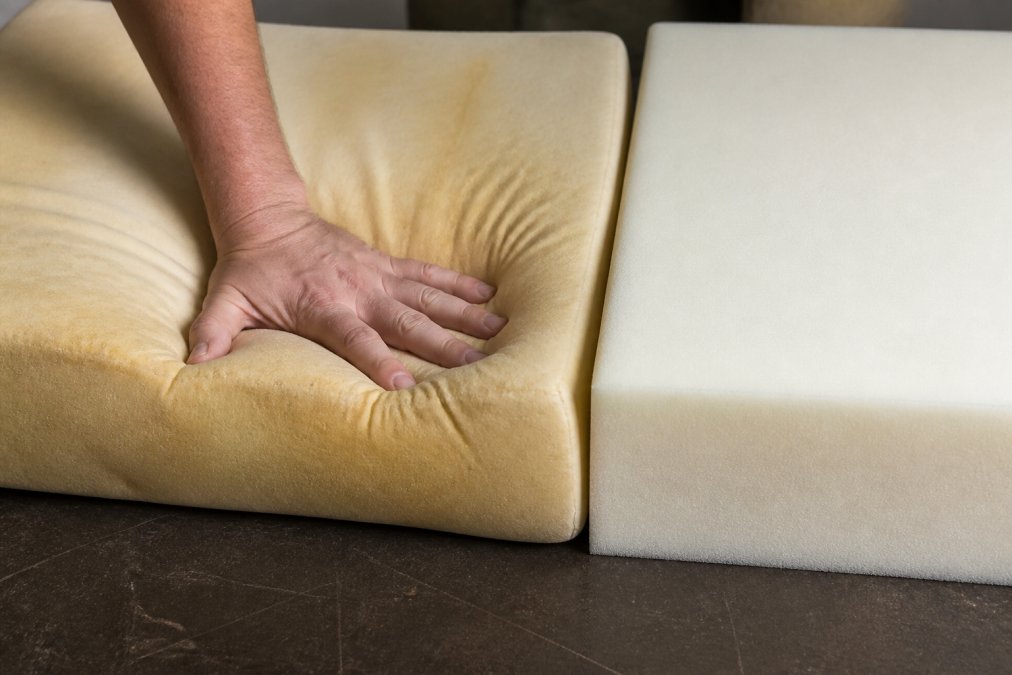
Visible sagging and permanent body impressions are the clearest signs that foam has reached the end of its service life. When a cushion or pad no longer returns to its original shape after pressure is removed, the foam has exceeded its compression set limit. Continuing to use it accelerates wear and tear because the remaining material bears more load than it was designed for.
Cracking and crumbling indicate chemical degradation, not just mechanical fatigue. Polyurethane foam that has been exposed to UV light, ozone, or extreme temperatures will eventually lose its tensile strength and begin to break apart. Polyethylene closed-cell foam is more resistant to this degradation, which is why it is specified for outdoor and construction use.
Loss of support is a functional failure that occurs before visible damage. If a cushion feels like it "bottoms out" under weight, or a backer rod no longer holds sealant at the correct depth, the foam has lost its load-bearing capacity. Replacement is the only option at this point; no maintenance protocol can restore degraded foam structure.
Professional foam products like the Oodles of Noodles 5 Inch Foam Tube Backer Rod are designed for extended service life, but no foam lasts forever.
Conclusion: Choose Professional Foam for Projects That Need to Last
The real cost of foam is not the purchase price; it is the cost of premature failure and replacement. For a one-season pool noodle, retail foam is fine. For a construction joint, a kayak stabilizer, or any project where failure means rework, professional-grade material is the only rational choice. The testing standards, density specifications, and cell structure differences we have covered give you the tools to evaluate any foam product critically.
FoamNoodles carries the full range of professional-grade foam products, from closed-cell backer rods for construction to bulk craft and padding materials. With bulk purchasing options and fast, free shipping, you can source the material quality your project demands without the retail markup. Our 1,239 customer reviews reflect the durability that comes from manufacturing foam to professional standards.
Get started with FoamNoodles and choose foam that performs as long as your project needs it to.
Frequently Asked Questions
Which foam is long lasting?
High-resilience (HR) polyurethane foam with a density above 2.0 lbs/ft³ and strong compression set ratings lasts longest. Closed-cell foams like polyethylene backer rod also resist moisture and degradation well. For cushions and upholstery, look for foam rated for 5-10 years of daily use. Professional-grade foam uses polymer structures that resist material fatigue, unlike low-density retail foam that breaks down in 1-2 years.
How do I test foam quality before buying?
Press the foam firmly and release. Quality foam springs back immediately with no visible indentation. Squeeze a corner between your fingers: professional foam resists compression, while low-quality foam collapses easily. Check the foam density chart 2026 for the spec sheet, and ask for indentation force deflection (IFD) values. A compression set test, where foam is compressed for 24 hours, reveals how well it recovers. Foam that holds its shape after this test will resist sagging longer.
How many years should a foam mattress last?
A quality foam mattress with high-density polyurethane foam (2.0 lbs/ft³ or higher) typically lasts 7-10 years. High-resiliency foam mattresses can last even longer. Low-density foam below 1.5 lbs/ft³ may show body impressions within 2-3 years. The foam density chart 2026 shows that higher density directly correlates with lifespan. Your weight and usage frequency also matter: heavier users compress foam more, so they should choose higher-density options for maximum durability.
Is high-resiliency (HR) foam worth the extra cost for home projects?
Yes, for projects where foam will experience regular compression like seat cushions, mattress toppers, or padding. HR foam costs about 20-30% more than standard high-density foam but recovers its shape faster and resists sagging up to twice as long. The polymer structure in HR foam uses different cell structures that better distribute load. For one-time projects like craft shapes or pool noodles, standard closed-cell foam offers adequate durability at a lower price.